
The ruins of Orval, living memory of Cistercian grandeur
Behind the active abbey lie the remains of a thousand-year-old monastery. An architectural and spiritual journey into the heart of Gaume's Cistercian history.
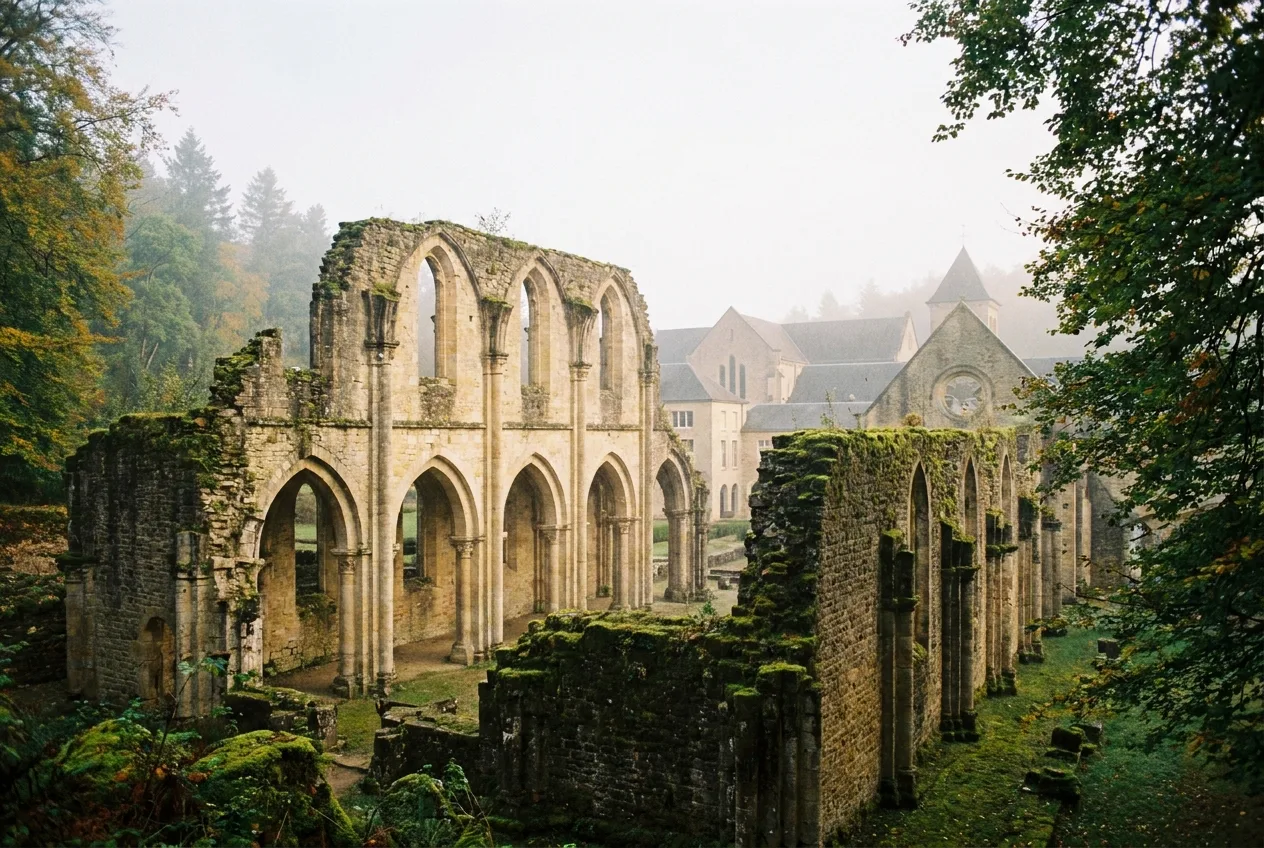
The shadow of monumental past
Visitors to Orval know the Trappist brewery and its modern abbey with clean lines. But how many take the time to explore the ruins stretching behind the contemporary walls? These remnants of the old abbey, founded in the early 12th century, tell nine centuries of Cistercian history. From Romanesque arches to broken Gothic vaults, every stone bears the mark of a community that shaped the Gaume landscape.
The ruins are not mere romantic scenery. They bear witness to learned architecture, remarkable hydraulic mastery, and intense monastic life that radiated far beyond Gaume's borders. The revolutionary destruction of 1793 did not erase this memory: it froze it in stone.
A path between stone and silence
Wandering through the ruins reveals the meticulous organization of a Cistercian abbey. One can make out the abbey church, the cloister, the chapter house where community decisions were made. Archaeological excavations have uncovered sophisticated water drainage systems, forges, and kitchens. Orval Abbey was not only a place of prayer, but an economic and cultural center of prime importance.
The pools and fountains scattered throughout the site remind us that water has always been at the heart of monastic life. The legend of Countess Mathilde and her ring recovered from the spring takes on full meaning here. These waters that gave Orval its name continue to flow, indifferent to the centuries.
A contemporary renaissance
Since the return of Cistercian monks in 1926, the ruins have found a new balance. Consolidated and enhanced, they dialogue with the modern abbey built alongside them. This architectural contrast is no accident: it illustrates the continuity of a monastic presence that survives the ruptures of history. The carefully designed gardens surrounding the ruins invite contemplation.
The site now attracts visitors from around the world, curious to understand what Cistercian life was like at its peak. The time-worn stones, sculpted capitals emerging from walls, carefully arranged perspectives: everything combines to make the ruins of Orval a place of memory and beauty. A place that reminds us that Gaume, far from major routes, was a spiritual and cultural crossroads of rare intensity.
Visiting the ruins of Orval means accepting to slow down, to raise one's eyes toward broken vaults that open to the sky. It means understanding that heritage is not only about conservation, but about dialogue between eras. And it means discovering that behind the fame of Trappist beer lies a far vaster legacy.
Want to discover the Gaume in person?
Six characterful houses, hot tub, walled garden — minutes from the sites we write about.
See the houses