
The Semois, wild artery at the heart of Gaume
Between deep meanders and wooded banks, the Semois has sculpted the most striking landscapes of southern Belgium for millennia. The story of an untamed river that refuses straight lines.
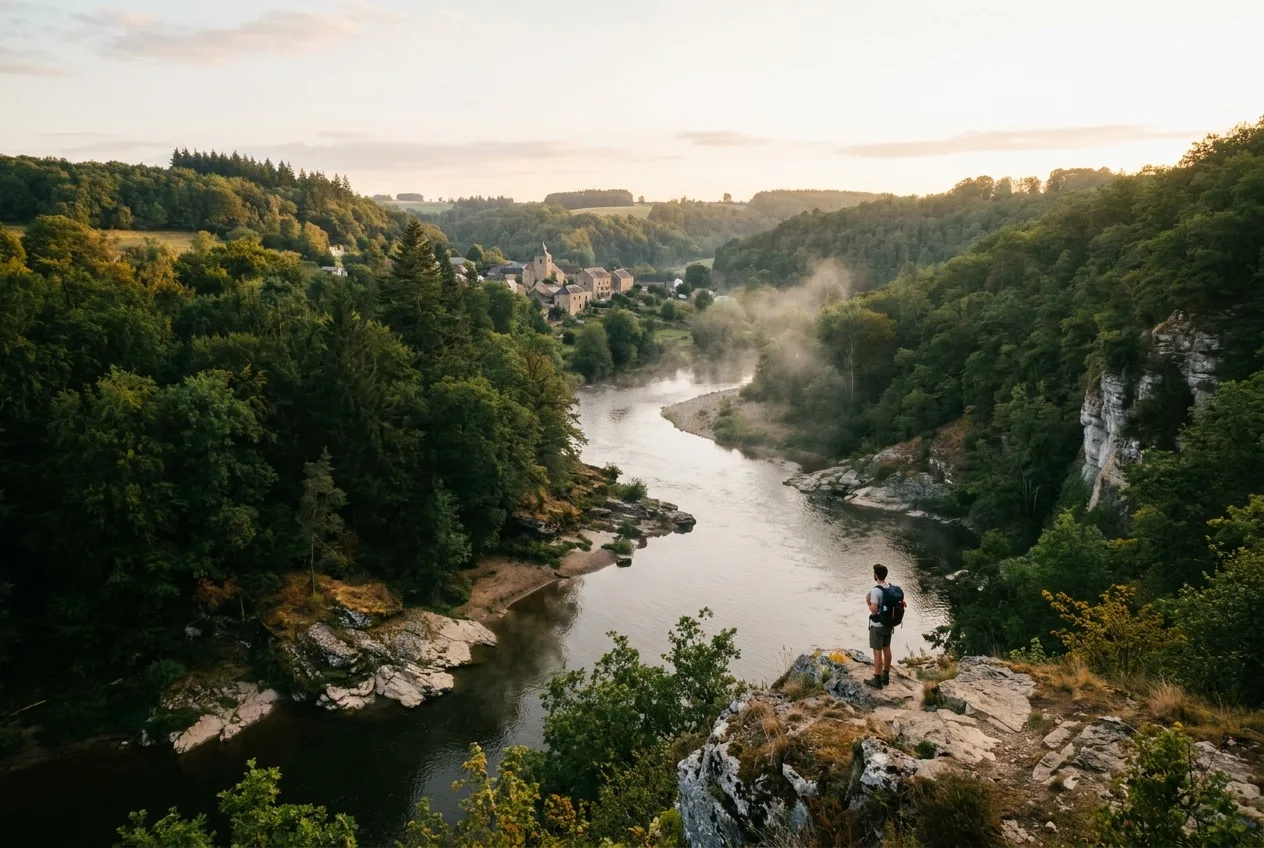
The Semois doesn't cross Gaume: it carves it, hollows it, shapes it according to its moods. Born in the folds of the Belgian Ardennes, this capricious river joins the French Meuse after a journey of nearly 200 kilometers, a generous portion of which winds through Gaume territory. Its passage has drawn suspended valleys, dizzying hairpin bends and slopes where the forest plunges down to the water.
A river that refuses geometry
The Semois knows no straight line. It twirls, hesitates, almost doubles back on itself, as if groping for its way. These deep meanders, cut into the schistose bedrock, offer spectacular viewpoints: from the ridges, the ribbon of water gleams between the dark masses of beech and oak groves. In Gaume, the valley widens slightly, giving way to wet meadows where a few Belgian Blue cattle sometimes graze. But the wild character remains: the river keeps its capricious rhythm, its brutal spring floods, its severe summer low waters.
The banks are a refuge for discreet but present wildlife. The kingfisher traces turquoise lightning bolts, the grey wagtail hops on the pebbles, and brown trout still find shelter in the cool waters. On summer evenings, you might spot a roe deer coming to drink at dusk, or a grey heron motionless like a bronze statue.
Walking along the water
Several trails follow the Semois in Gaume, offering walks of rare intensity. No need to seek heroics: a few kilometers are enough to grasp the soul of the place. The path embraces the river's curves, crosses undergrowth where humus smells of autumn even in June, emerges onto unexpected clearings. You encounter patient fishermen, picnicking families, solitary walkers who come here for the silence.
The Semois also tells the human history of Gaume. The mills, now dormant or transformed, bear witness to a time when water was motive power. Stone bridges, discreet and solid, have connected villages for centuries. And on the heights, a few street-villages have clung far from the river's whims, cautious of spring anger.
A beauty that doesn't shout
The Semois is nothing like an easy postcard. It doesn't reveal itself at first glance. You must accept walking, taking your time, sitting on a flat rock to watch the water flow. It belongs to that category of landscapes that reward being frequented rather than admired in passing. In Gaume, where the relief is gentler than in the Ardennes, the river brings a welcome note of wildness, a reminder that nature keeps its secrets even beside marked trails.
In June, when vegetation explodes and ferns unfurl their fronds along the banks, the Semois offers a spectacle of magnificent sobriety. No grandiloquence, just the quiet evidence of a river doing its river work as it always has.
Want to discover the Gaume in person?
Six characterful houses, hot tub, walled garden — minutes from the sites we write about.
See the houses