The stag's roar: October wakes the Semois valleys
Two guttural calls echo through the mist. In early October, the Gaume forests vibrate with the stag's roar — a spectacle you listen to without seeing.
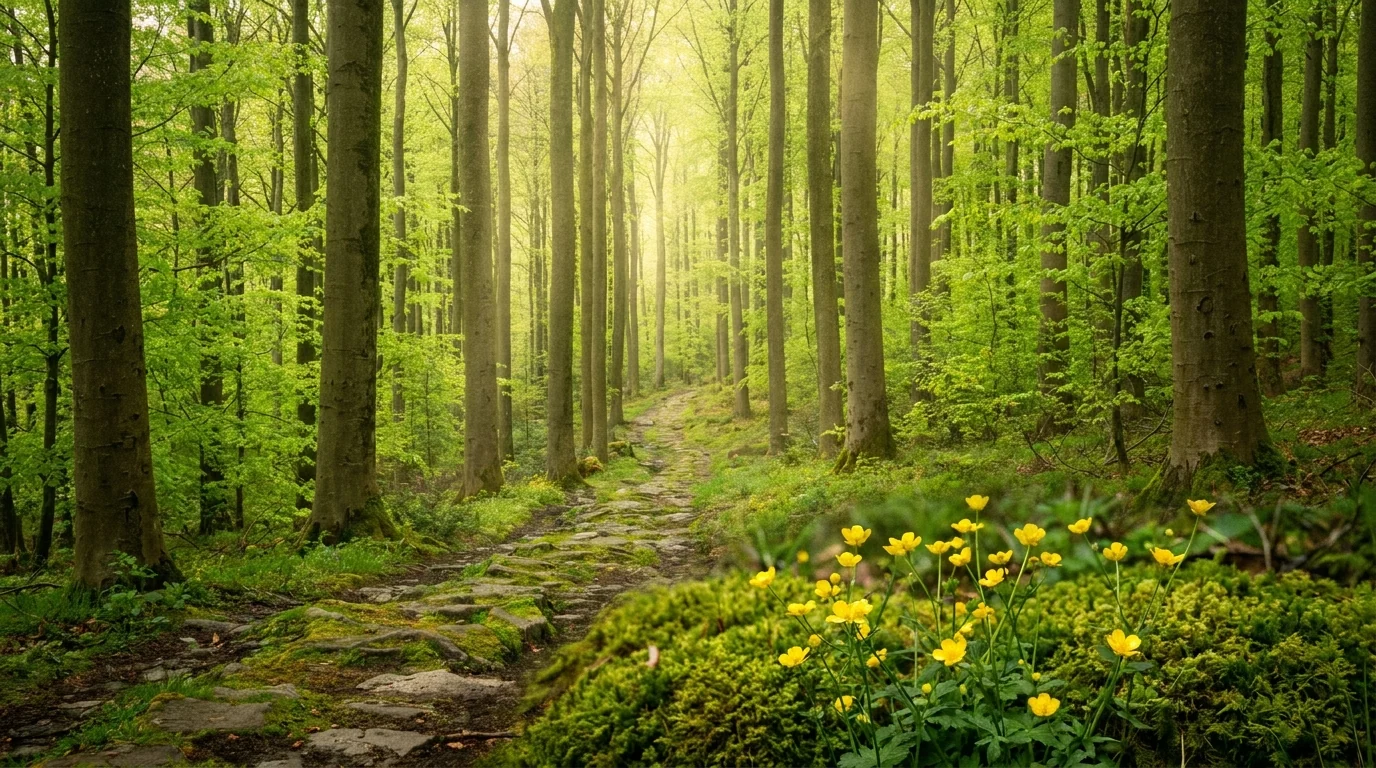
It is six in the morning. The Semois has stopped flowing, or nearly so: dawn holds it in a cotton-soft silence. Then, somewhere above the beech woods, a throat tears open. A deep, guttural rumble that seems to rise from the rock itself. The stag is roaring. And the air around you changes its very texture.
You cannot see it. You only hear it. It is almost better that way. For the October roar in the wooded hollows between Florenville and Bouillon is not a show you consume. It is a primitive jolt, a vibration you feel in your breastbone before your brain has had time to name it.
Valleys that resonate
The Gaume, with its limestone slopes carved by the Semois and its mixed forests of oak, beech and hornbeam, offers the red deer a land of choice. In this first week of October, adult males leave the anonymity of the undergrowth. They climb to the ridgelines, scrape the earth with their forelegs, and unleash a call that cuts through the mists like a challenge.
The roar is not a song. It is a warning, a joust, a rale of raw power that can carry for several hundred metres through the early-morning silence. Two stags answering each other are enough to turn an ordinary morning into an event. You do not seek to locate the winner: you simply listen as the space fills with controlled violence.
Watching without disturbing
The region's footpaths — those that hug the river bends or climb toward the plateaus — are walked by discreet ramblers from dawn onwards. Gloves, a thermos, patience. Watching the rut does not improvise: you must learn to stand still, to stay quiet, to let the wind come to your face. The stag's ears are high and his nose even keener. One snapped twig, and the valley falls silent as though by magic.
This is not a hunt. The very word is a misnomer here. You take nothing. You take the temperature of a season, you gift yourself an hour suspended between night and day. That is all, and it is already more than enough.
The Gaume, a silent kingdom
For centuries, the deer's presence shaped the life of these villages. The lords of Bouillon reserved the hills for themselves; the farmers, too, heard the roars from their courtyards, like a tocsin of the natural calendar. Big game was a seasonal sign, on the same level as the first frost or the return of storks to the church steeples.
Today, the deer has crept back into the awareness of walkers. It is no longer watched out of hunger or seigneurial right. It is watched out of wonder. Out of a desire to remember that a wild throat still exists, three hundred metres above the stream, where the moss knows nobody's name.
October, in the Gaume, holds nothing spectacular. The light fades faster, the beeches begin to blush at the edges. But listening to the roar just once, at daybreak, is enough to understand that this land has kept a voice. Hoarse, deep, indifferent. And infinitely precious.
Want to discover the Gaume in person?
Six characterful houses, hot tub, walled garden — minutes from the sites we write about.
See the houses