
The Charcoal-Maker of the Beech Forest: When Gaume Smoked Under the Clamp
From the beech woods near Florenville to the Semois valleys, Gaume burned its timber for centuries to feed the iron forges across the border. The clamp is gone, but the memory still smoulders.
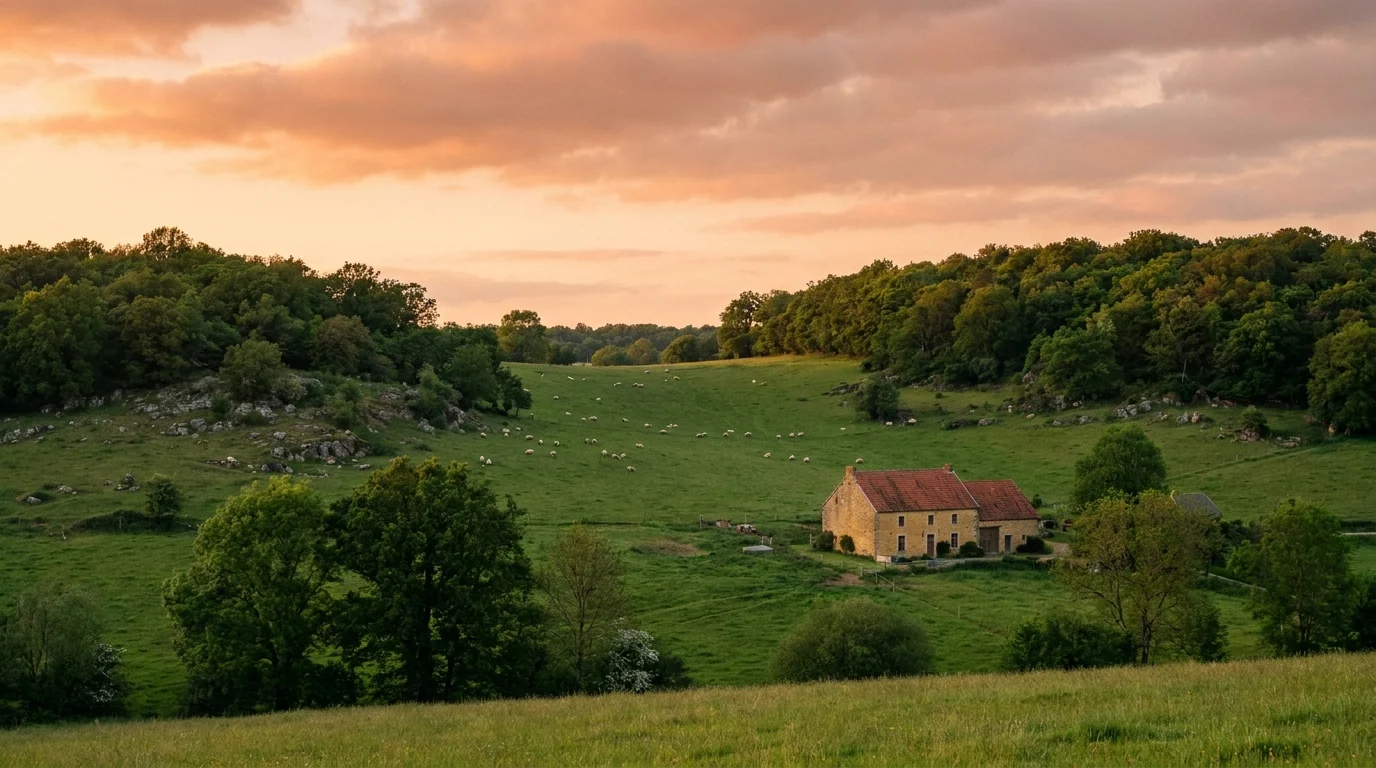
October. The last beech leaves turn gold around Florenville. Under my boots, the moss carries that dark, ashy shade that betrays old fires. Here, a century back, a man watched for weeks a cone of stacked wood consume itself in smoke, feeding the iron forges of neighbouring Lorraine.
The Clamp, an Architecture of Earth and Fire
The charcoal clamp was an act of faith. The charcoal-maker piled beech trunks into a cone, sealed it with brushwood, moss and a crust of earth. Then he lit the base and waited. For days, sometimes weeks, the fire had to breathe — not blaze, not die, just smoke. One too-large air-hole, one patch of moss in the wrong place, and the whole alchemy could tip. Too much air and the wood went to ash. Too little, and it stayed a raw log.
It was solitary, seasonal work. The charcoal-maker camped beside his clamp deep in the beech forest, eating cold, listening to resin crackle in the dark. Across Gaume, where beech woods stretch from the Semois valley to the heights of Étalle, these mounds dotted the forest each summer. Whole families moved wood by wood, rebuilding a fresh clamp every month.
Gaume's Wood Heated Forges Elsewhere
The charcoal did not stay in Gaume. It left in sacks on donkey backs or by cart, toward the blast furnaces of the Meurthe valley and the Meuse basin. The great forges of the Pays-Haut needed tonnes of this black, porous fuel to melt ore. Gaume, poor in mineral wealth, was rich in timber — and its wood, slow-baked into charcoal, became the currency of a cross-border economy.
This is what made the charcoal-maker a figure of passage. Neither quite a forest labourer nor quite an industrial actor. He belonged fully to neither side of the frontier. His knowledge lived in his hands, passed from father to child, and he carried it across the linguistic line that divides Gaumais Lorrain from the French of the Meurthe.
The Phantom Scent Beneath the Beeches
Today the clamps are gone. Industrial coke replaced wood-charcoal; gas replaced wood in the forges. The last charcoal-makers of Gaume faded around the middle of the last century. Walking the old forest paths, you can still spot the circular scar in the ground, the blackened soil that resists grass. Locals call it a «brûlis» and stop over it the way one stops before a ruined chapel.
But the forest holds no grudge. The beech stand regrew, as it always had, managed now for timber, for mushroom-pickers, for hikers and the raptors riding thermals above the Semois. The charcoal-maker's craft is not entirely dead — a few enthusiasts rebuild clamps for demonstrations, and old songs survive in village memories. But the smell, that acrid sweetness of green beech smoke trapped under earth, is a scent that belongs now only to the past.
October is the month when you can almost catch it. Between the rotting leaves and the first stove-fires, the air over the Gaume hills still whispers of a slow, patient burning.
Want to discover the Gaume in person?
Six characterful houses, hot tub, walled garden — minutes from the sites we write about.
See the houses