Gaume's dry grasslands: when limestone keeps the light
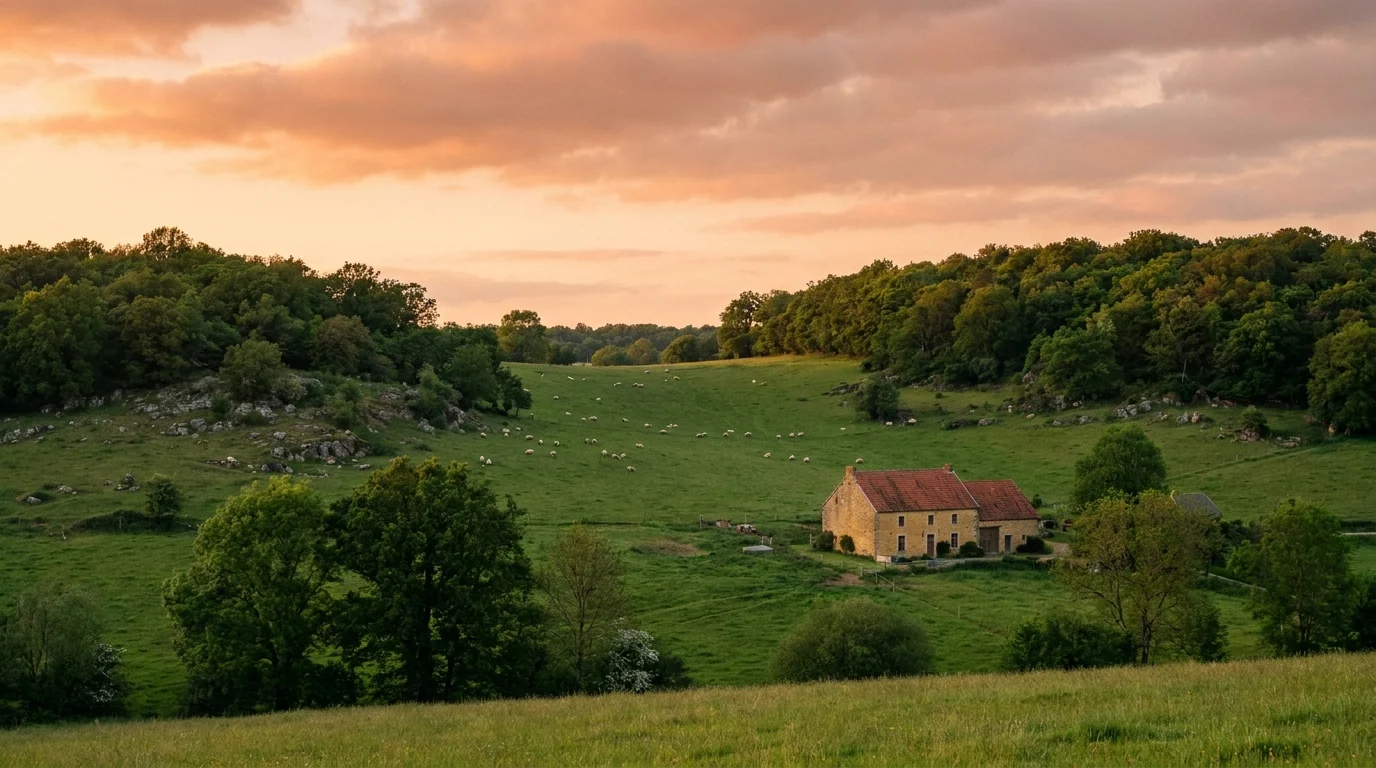
On the plateaus above the Semois, a thin carpet of short grass on scorched limestone draws a landscape no forest will reclaim. In October, it fades out gently.
The carpet that doesn't grow like the others
In Gaume, the earth is limestone. On the plateaus above the Semois and the Ton, centuries of grazing and poor soils kept open what elsewhere would have long since become forest. The dry grasslands — these lean meadows laid on soft stone — are Gaume's most fragile landscape signature. In October, they take on a pale gold, almost luminous hue. The grasses have gone to seed; the flowers gave up arms long ago. What remains is geometry: tufts, curves, the slow breathing of the plateau beneath a low sky.
You won't find them in a guidebook spread. The dry grassland doesn't perform. It resists. On the slopes of Montquintin, near the castle ruins, above the ravines where limestone drinks the rain, these grasslands cling to a handful of centimetres of soil. The stone holds the sun's warmth long after the forest below has gone dark. That's why these flowers arrive early, and why they are slow to fade.
The hidden orchid, the forgotten ewe
In May and June, the dry grassland ignites. Orchids — monkey orchis, military orchis, spider ophrys — erupt between the fescue tufts. Butterflies follow: blues, heath fritillaries, coppers. Gaume ranks among the last Belgian refuges for some of these species. Then summer empties them. In October, the spectacle shifts: to the dry crackle of stems underfoot, to the smell of warm limestone releasing its mineral breath, to the sight of one last orchid leaf, curled and brown.
For generations, a flock of sheep — hardy, stubborn, sustained by almost nothing — kept these grasslands open. No tractor, no plough. Just constant nibbling, trampling, the slow enrichment of thin soil by hooves. The shepherd was part of the landscape, as essential as the slope itself. Today, a handful of shepherds still tend these plots. Without them, brambles return, then hawthorn, then oak. Twenty years of abandonment and the grassland becomes a thicket. The orchid disappears.
What the hill holds onto
October is when you understand why the dry grassland matters. Not for the postcard. For the silence between the trees. For the way light hits the plateau at four in the afternoon, this time of year, when the sun is already low over the Lorraine border and casts long shadows across the grass. For knowing that somewhere in this thin soil, a seed waits for April.
Walk the plateau above Latour, or the ridgeline toward Sommethonne. The path carries no grand signpost. Gaume doesn't announce itself. It offers a worn stone bench, a horizon that folds into the French Ardennes, and the quiet insistence of a landscape that asks only to be crossed, not photographed.
The dry grasslands will still be there in November, in December, under frost. Golden, then grey, then white. The same geometry. The same patience. That is the Gaume way: to hold, long after everyone else has looked away.
Want to discover the Gaume in person?
Six characterful houses, hot tub, walled garden — minutes from the sites we write about.
See the houses