The Towers of Latour: When Gaume Straddles Two Countries
At Latour, the border divides nothing: it cuts through the dining room, the school path, the memory of one shared village. One foot in Gaume, the other in Lorraine.
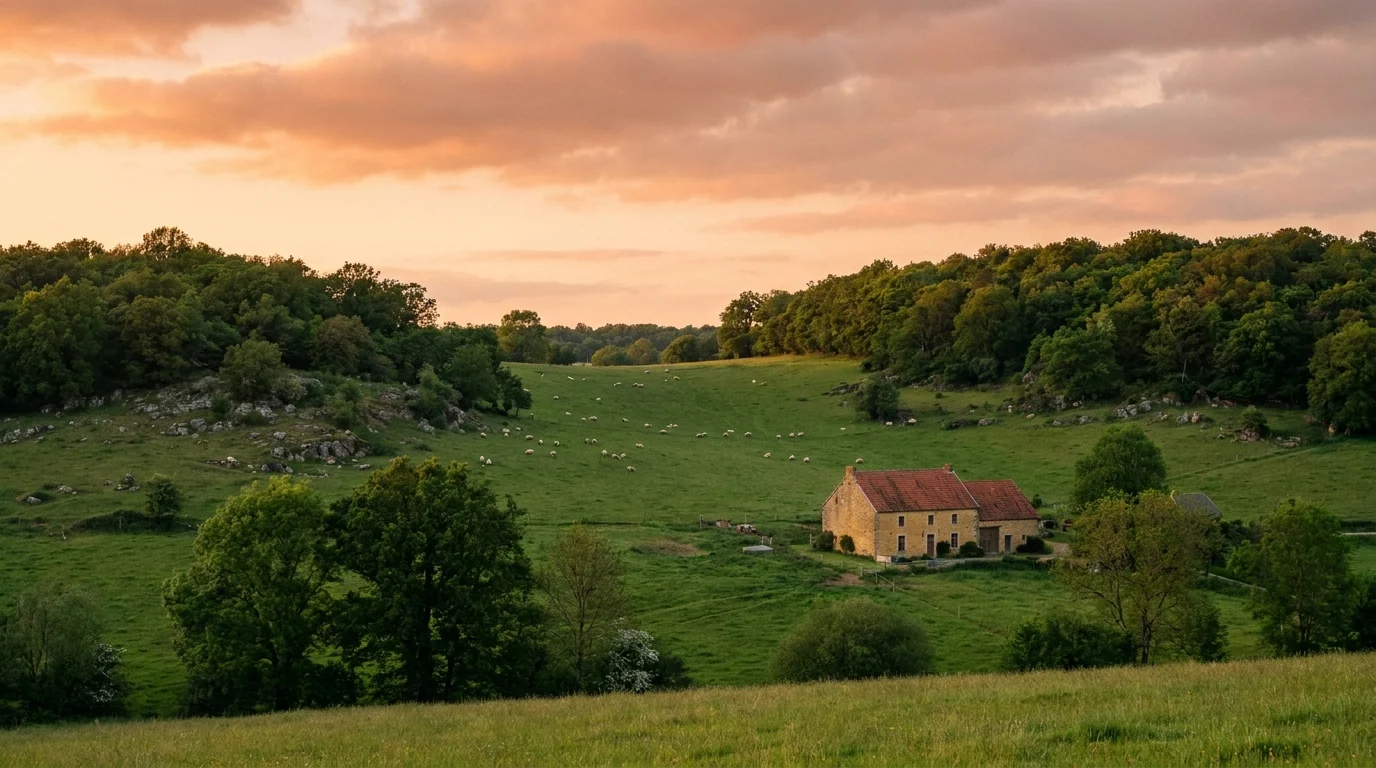
You reach Latour by gently descending from the Gaume plateau, along the small road that slopes down toward the Chiers valley. From a few hundred metres away, the towers already appear: two half-eroded stone silhouettes perched on the ridge like broken teeth in a jaw of limestone. They give the village its name. They also give it its mute pride, somewhat surly, a little tired of being the last stop before France.
For Latour is exactly that: a double village, cut without ceremony by the border line drawn in 1839. On the other side of the Chiers, a French hamlet bears the same surname, the same family names. People say "on the other side" without specifying they are crossing a border, so short is the path and so identical the Gaumais dialect.
The stones that hold the name
The towers are Romanesque, or rather what remains of them: thick foundations, a few courses of rubble masonry still standing, an empty gap between the two that lets the west wind through. One imagines a keep, an enclosure, a watch point over incursions from the direction of Sedan. Today, they are not really open to visitors. You look at them from the bottom of the village, you circle them, you rest your hand on the warm stone and feel how centuries of frost and rain have polished what survives.
The rest of the village has kept a typical Gaumaise architecture: houses in rendered rubble stone, arched doorways, low-pitched roofs in tile or slate. The upper farms stand face-on to the wind; the lower ones shelter in the hollow. No grand monument. No central square. A wash-house, a fountain, the road that leads down toward Signeulx or climbs toward Villers-devan-Orval.
A village without seams
What strikes you at Latour is the sheer absence of solemnity around the border. The school, the bistro, the funerals: everything plays out in a ten-minute walk, one side then the other. People speak a Gaumais that hovers between Walloon and Lorrain, with intonations on either bank of the Chiers that are perfectly interchangeable. The children of the "French side" and those of the "Belgian side" played in the same meadows, climbed the same trees, came home for the same soup.
This everyday porosity never made the line cease to exist. It simply stopped being an obstacle and went back to what it was before the treaties: a stream, a hedgerow, a footpath used more than another.
The memory of ridgelines
From the path linking the towers to the upper farm, the view opens like a fan. To the north-west, the hill of Signeulx. To the south, the Lorraine plain climbing back toward Montmédy. To the east, the Gaume plateau rounding off toward Torgny and its vines. The wind bends the dry grasses of the limestone meadow. You hear a bell tower, but you can no longer tell which: the Belgian or the French one. Perhaps both at once.
Latour is nothing of a heritage-listed site. It is a village that endures because it is twisted between two states, two tax systems, two ways of pronouncing the word "bread." And that is perhaps why it remains so little visited, so strangely intact, like a secret you would gladly share but keep to yourself anyway, on a Sunday in October, between two slices of cûtchau.
Want to discover the Gaume in person?
Six characterful houses, hot tub, walled garden — minutes from the sites we write about.
See the houses