Raptors of the Meanders: When the Semois Calls the October Sky
In October, thermals along the Semois draw buzzards, kites and sparrowhawks. A silent spectacle above bends of limestone and beech.
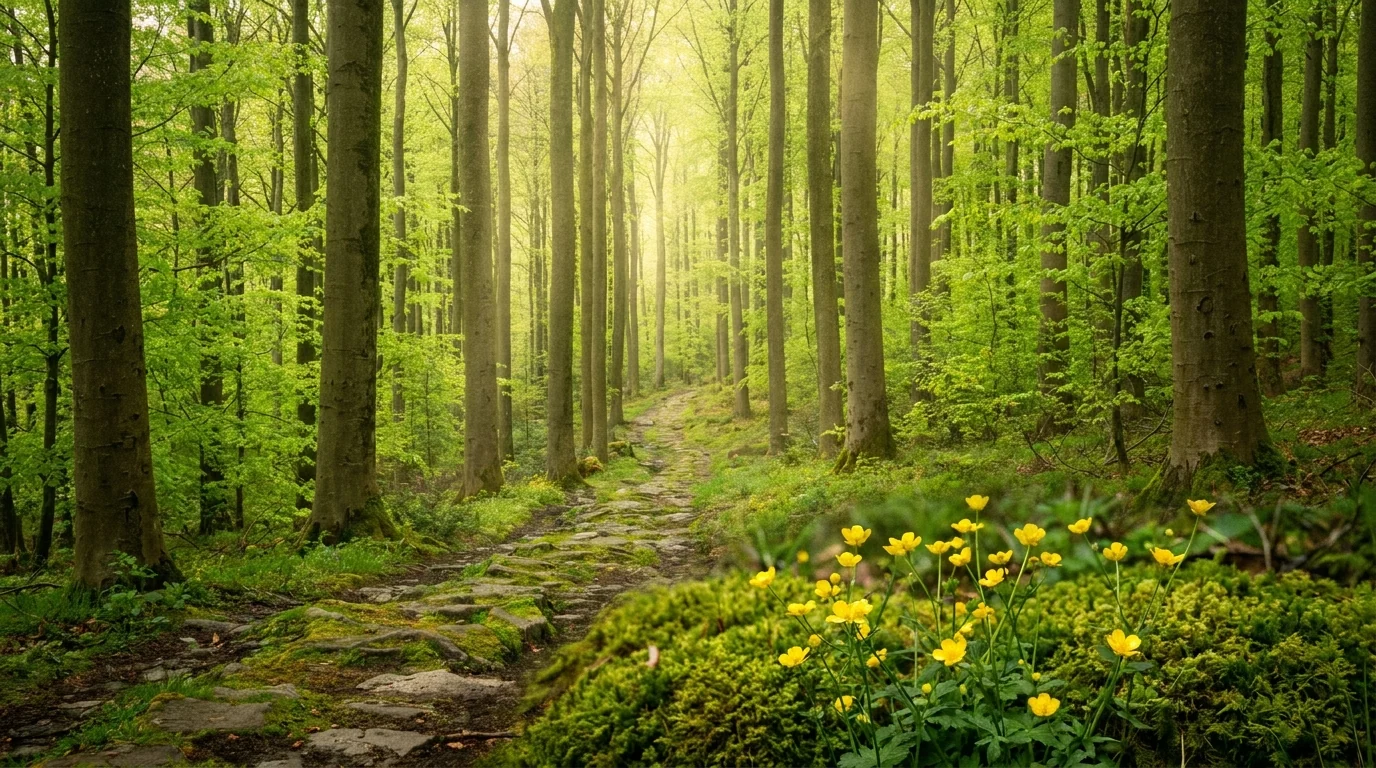
In October, when the last thunderstorms have washed the Gaume sky clean, another spectacle plays out above the meanders of the Semois. Not the deer rut that shakes the beech forest, nor the vines turning red in Torgny. No: the spectacle of wings. Migrating raptors ride the thermal columns rising above the limestone slopes, and the Semois — with its tight bends framed by oak woods and open meadows — becomes a highway of the sky.
You don't really expect them. You are there, on a ridge path between Bohan and Poupehan, or along the Dohan, and suddenly a black kite draws a perfect arc in the thermals. Then two. Then six. They circle without beating their wings, frugal, almost insolent in their mastery of the wind.
Thermals and the geography of wings
The Semois does not flow in a straight line. It snakes, it coils, it isolates wooded peninsulas the size of a village. This geography creates heating discontinuities: the dry grassland of the plateau, the dense forest at the bottom of the loop, the white limestone that reflects light. Each transition between these environments generates a column of warm air, and that is precisely what the raptor seeks in order to climb without effort.
The trained eye recognises the common buzzard — that broad, slightly clumsy silhouette, gliding low above the meadows while scanning the ground. Higher up, almost invisible, a hen harrier skims over the tall grasses of the floodable meanders. And then there is the sparrowhawk, small, fast, crossing the valley like an arrow before vanishing into the beech wood.
A celestial court without protocol
What strikes you is the coexistence. On a single October afternoon you can count a good dozen species or so on the same ridge line — if you add the crows and starlings, who have nothing graceful about them but take up a great deal of space. The black kite, with its forked tail, is the master of the thermal. The buzzard, heavier, prefers short powered flight. The goshawk stays hidden in the spruces and shows his barred belly for just one instant.
No one has organised a kermesse for them. The villages along the Semois do not put them on the programme. And yet they are there every autumn, faithful to a millennial route, and the Gaumais who lifts his head from his vegetable garden in Florenville or Montquintin no longer sees the same thing as a city child: he recognises a silhouette, an altitude, a flight that says winter is advancing.
Watching without hurrying
Raptor observation in Gaume demands a single thing: stopping. No telescope required, no technical notebook. Just a corner of a path, an hour, the silence of an October morning when the mist still clings to the bends of the Semois. Walkers on the RAVeL sometimes lift their eyes. The hikers on the Bohan ridges do so often. But it is the old man, on his doorstep, who names each bird like a neighbour you greet without hurrying.
October is the right month. The leaves fall, the horizon opens, thermals become rarer and the raptors concentrate on the few currents that remain. After that, one must wait until March for the return of spring migrants. Until then, the Semois turns beneath a less populated sky, and the village finds its sole company again: the wind in the beeches, and the wood smoke that rises, too, towards the empty sky.
Want to discover the Gaume in person?
Six characterful houses, hot tub, walled garden — minutes from the sites we write about.
See the houses