
Maitrank pie: when Gaume keeps spring sealed inside a golden crust
In October, as mist swallows the Semois valley, maitrank pies leave Gaume's village ovens. A golden crust, a green syrup, and the whole terroir of a borderland served on a single plate.
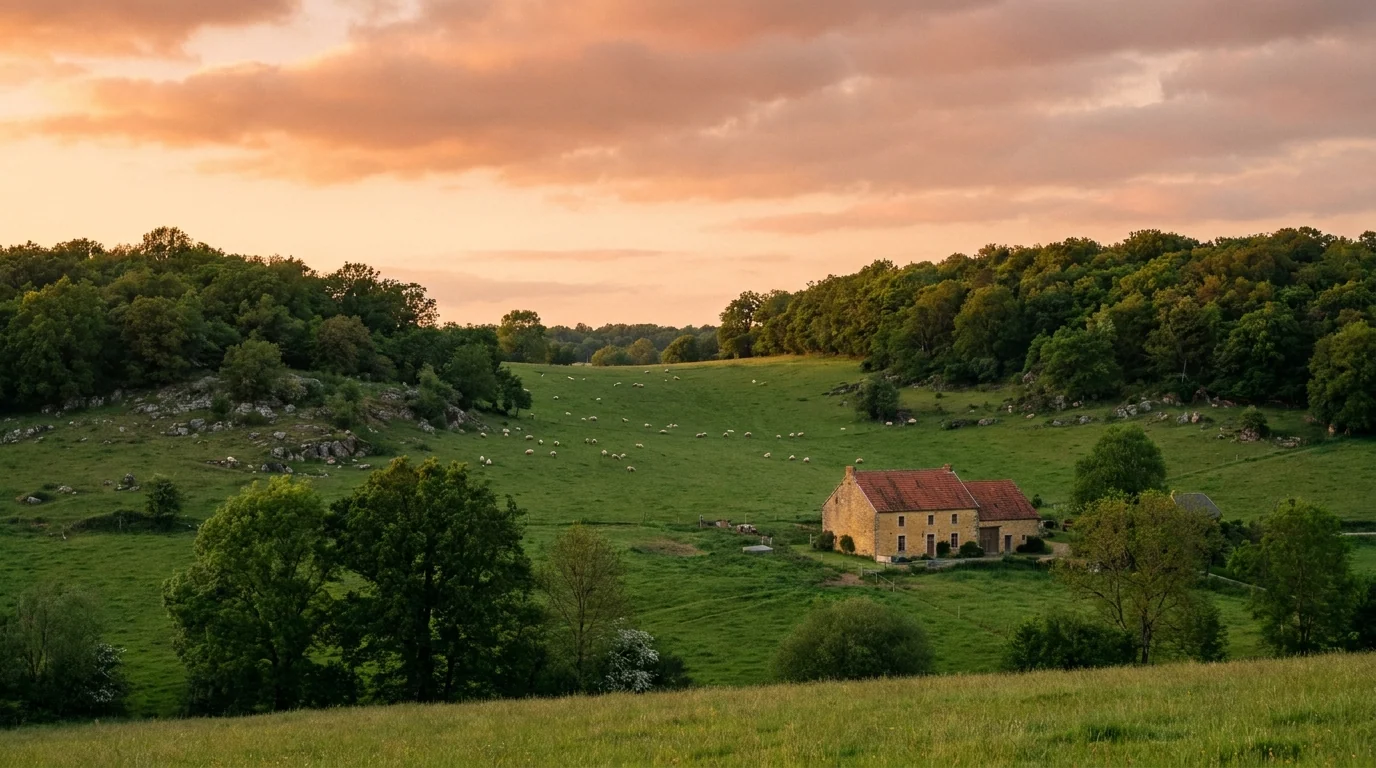
By seven in the evening, the light is already gone, and the Semois reveals itself only through its murmur in the darkened valley. In a stone farmhouse near Virton, a pie slides out of the oven. The crust swells upward, domed and bronzed at the lip. The smell of smoked pork mingles with something green, faintly menthol. That is maitrank — the sweet woodruff that flowers in April along Gaume's hedgerows and which, distilled into a syrup, perfumes the filling of a pie eaten all year round.
Maitrank pie is not a seasonal dish. It is a dish of patience. The woodruff is gathered in spring, steeped in alcohol, clarified into syrup, and stored for months before it returns to an oven. October in Gaume, with its first frosts silvering the dry meadows, is when one craves a thick plate — one that stands up straight and tells a story longer than the meal itself.
The green syrup and the crust that refuses to crack
Gaume's pie crust is recognisable by its thickness. Neither a French puff pastry nor a brittle shortcrust: a lid that crackles on top while staying tender underneath, built with a little lard and a good deal of wrist strength. The baker crimps the edges into a pierced wreath — a « window » that lets the meat breathe inside. Beneath that crust, you find diced pork shoulder, sometimes a sliver of local dry-cured ham, a few sweet onions softened in their own juice, and above all that thin ribbon of maitrank syrup which lends the cooking liquor a green bitterness you cannot quite name unless you grew up tasting it.
The syrup itself is a small heirloom object. You learned from your grandmother, or from the old vintner up at Torgny who sold his bottles at the kermesse counter, that maitrank — Galium odoratum, the scholarly name no one in Gaume ever says — must not be cut too early or heated too hot. Too much heat and the flower loses its perfume. Too little and the syrup stays flat. A whole generation of bakers and village cooks settled that recipe on the kitchen threshold, between two glasses of Orval.
From the bakery counter: a dish that says « village »
In the hamlets of the Chiers valley and the Semois tributaries, maitrank pie is still ordered from the local baker — the one who knows your name and tucks your pie aside if you say « for Saturday ». It is a purchase made in passing, like a wave at the fuel pump in Sommethonne or a chat about a log of beech outside Montquintin's town hall. The pie is not delivered, not clicked on an app. You collect it warm, wrapped in parchment so thin a thread of green juice always seeps through.
That gesture matters. It says Gaume's cooking was never restaurant cooking; it is counter cooking, pig-fair cooking, June-kermesse cooking. The woodruff grows in the undergrowth; the pie emerges from a wood-fired oven or, at best, a neighbourhood electric one. Between the two, a chain of know-how balanced on three or four pairs of hands, sometimes fewer.
The plate that carries the border
One could argue that maitrank pie is the most « Gaume » dish you can set on a table — more so than head cheese or the round cûtchau cake. It borrows from Lorraine its smoked meats, from neighbouring Champagne-Ardenne its hedgerow herbs, from the Grand Duchy across the river its bakers who cross the border every morning. Maitrank is a symbol: it flowers as the beeches leaf out, marking the end of winter, and yet we eat it in October, November, February, when the window looks out onto a drizzle that bears no resemblance to April.
The pie keeps that contradiction. It is spring stored up, a season packed into a golden crust, a green brightness warmed on an All Saints' evening. Bakers from Virton to Florenville still pull these pies out at six, before the RAVeL walkers come home soaked. You cut thick wedges, eat standing up, with dark bread and a dab of strong mustard. And somewhere inside the crust, the smell of April lingers. That is the whole secret of Gaume: stretching one April perfume until the first frost arrives.
Want to discover the Gaume in person?
Six characterful houses, hot tub, walled garden — minutes from the sites we write about.
See the houses