
Viaducts Under Falling Leaves: Walking Gaume's Forgotten Rail Lines
Late October, beeches drop their last copper leaves onto old railway ballast. Beneath the stone arches, no whistle lingers — only the walker's step and wind threading through the tunnels.
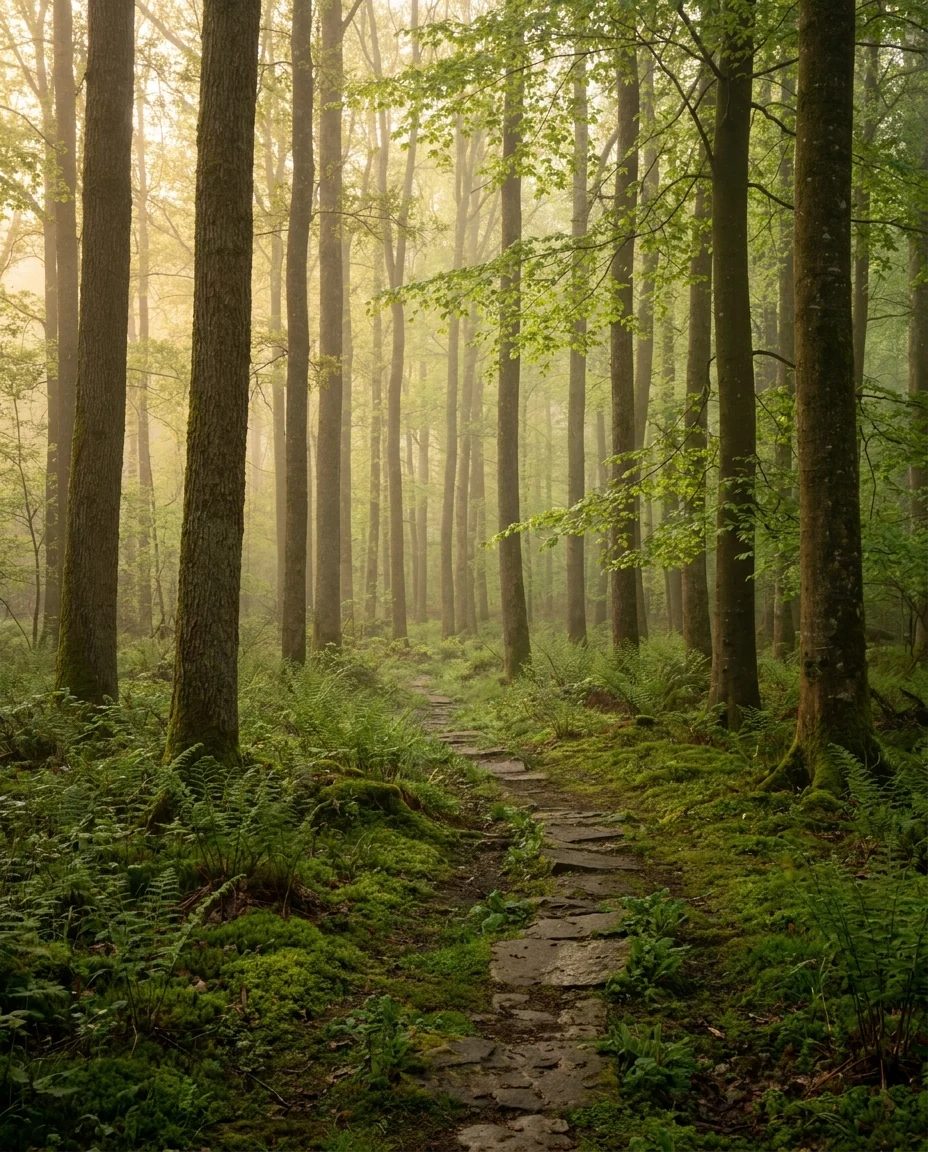
Ballast Beneath the Beeches
You walk through low October mist, between Virton and the southern villages. The path is wide, flat, lined with old coppice that the beeches crown in a burnished copper hue. Underfoot, a hard, even surface: not a road, not a dirt trail. It is the bed of an old railway line, turned public thoroughfare by the RAVeL programme.
The last train blew its whistle long ago. The rails were torn out, the sleepers carted away. But the geometry remains. The interminable straight, the gentle curve cresting a hill, the cutting carved into the limestone. Gaume now walks where it once carried iron ore, sugar beet, and farmers bound for the neighbouring village station.
Stone Arches, Mouths of Darkness
What these paths retain, above all, are the structures. Viaducts of two or three arches, flung across a stream barely visible beneath the undergrowth. Limestone rubble, laid with clockwork regularity, patinated by half a century of rain and lichen. You notice them now that the thinning canopy lets light through: the arch stands out, crisp, against the low sky.
And then the tunnels. Short, low-vaulted, cut into the vein of blue-grey stone. The walker passing through feels the air cool sharply, hears her own breath returning as echo from the far portal. Gaume's limestone, quarried to build the area's churches and farmhouses, also hosted these industrial piercings. One and the same rock, two destinies.
Some decommissioned station buildings still stand along the route. Brick-sealed windows, machine-made tile roofs, enamel nameplates faded by the seasons. Owned by private individuals or disappearing under ivy. They keep the exact shape of waiting: a place where one stood to take the train to Luxembourg, to Longwy, to the county seat.
The Walker's Step, the Only Sound Left
In late October, the light already fades past four in the afternoon. Gaume's sky drapes itself in a uniform veil, grey and gentle. On the RAVeL, a few cyclists in fluorescent vests overtake the walker. The rest is leaf-sliding, a jay's cry in the beech forest, the trickle of water beneath the arch.
This is the ideal season for these paths. Not the throng of warm days, not the mud of January. Leaves fall one by one, baring the masonry, revealing mortar joints, root claws prising apart residual ballast. Each bend of the line draws out an unexpected view: a village spire, a pasture bank, the dark line of Lorraine's spruces in the distance.
Walking here means reading a geography drawn by others, a century ago, with iron tools and gunpowder. Gaume has not forgotten the train whistle. It simply let it dissolve into the sound of falling leaves.
Want to discover the Gaume in person?
Six characterful houses, hot tub, walled garden — minutes from the sites we write about.
See the houses