
The barn owl in the belfry: Gaume puts on the dark too early
In November, the village surrenders to night before five and a pale shape glides over stubble. The barn owl has found its hunting ground.
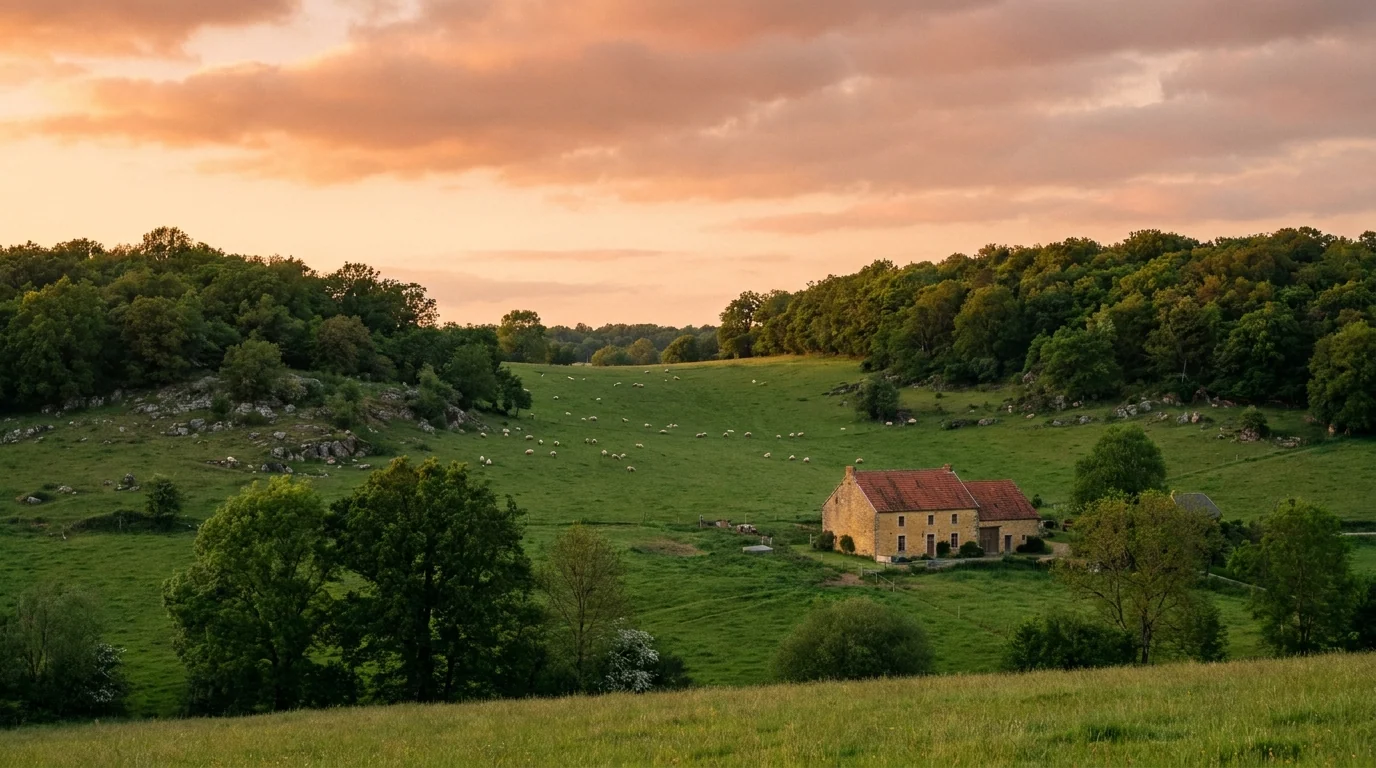
It is half past four in the evening, and Gaume has already given up on daylight. The days are shortening fast, clouds snag on the hillsides, and the village hunches behind its shutters. In this premature darkness, something crosses the silence: a white form, broad-winged, soundless, skimming the still-warm stubble of the autumn harvest.
The spectre above the fallow fields
The barn owl — sometimes called the white owl, though it is not an owl at all — is the most discreet nocturnal hunter of our Gaume countryside. It does not haunt legends; it hunts. In November, field voles, uprooted by ploughing, run exposed across bare parcels. The owl takes advantage. It flies low, slowly, its facial disk aimed at the ground like an antenna, and drops on its prey without a rustle.
You recognise it by that improbable silhouette: a cream cape, a heart-shaped breast, black eyes that see not in light but in the deepest dark. It does not hoot, does not saw the night like the tawny owl. It is mute. That silence, that ghost's flight, is what unsettles the late walker on the dirt path behind the washhouse.
The belfry and the barn
To nest, the barn owl seeks old enclosed spaces: church lofts, farm attics, bricked-up openings in rubble-stone walls. Gaume offers dozens of such refuges — the villages around Virton, Latour, Torgny, the hamlets of Sommethonne or Montquintin keep in their rural architecture the niches the bird favours.
Yet those attics get restored, those belfries renovated, those old barns converted. The stone is renewed, and good. But the thirty-centimetre gap through which the owl entered each spring vanishes beneath new insulation. It is a tiny, invisible trade-off that nobody documents, played out in every building site in the village.
Keeping watch without hearing a thing
What one waits for, in November, sitting on a log by the hedgerow after dusk, is not a spectacle. Just a presence. The village has gone quiet, the neighbour's tractor has stopped coughing, the dogs have settled. And there, between the beet field and the willow hedge, a veil of feathers crosses the last residual glow. Three seconds, four. Then the dark closes over.
There is no message, no omen. It is a bird, three centimetres of hollow bone and twenty grams of heart, eating field voles under a starless sky. But in that silence, in this village that turns in too early, that small white shape is enough to remind us that Gaume does not belong only to those who farm it. It shelters other night-watches, older than ours, who need not be named to exist.
Want to discover the Gaume in person?
Six characterful houses, hot tub, walled garden — minutes from the sites we write about.
See the houses