
The sandstone crosses of Gaume: when the stone prays at the roadside
Between Virton and Torgny, sandstone crosses have watched over rural crossroads for centuries. They don't preach: they signal, protect, and tell the story of a village.
At the crossroads, a silhouette
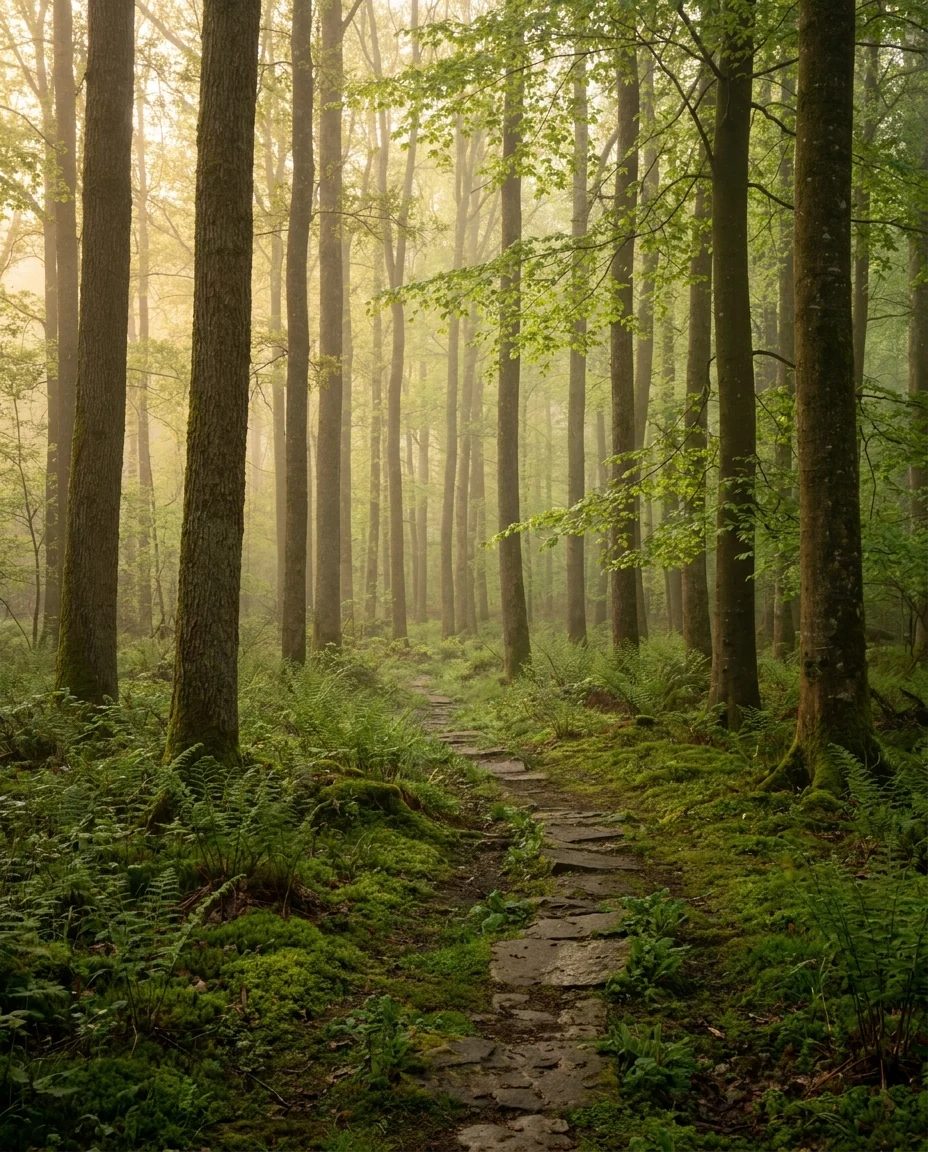
In November, the low light grazes the sunken paths and draws, at every junction, the long shadow of a sandstone cross. There it stands, set into a bank or resting on a stone pedestal, often tilted, sometimes half-buried under moss and ferns. Almost no one stops anymore. And yet, this is one of the oldest and most understated pieces of heritage in rural Gaume.
These crosses number in the hundreds between the villages of the Ardenne gaumaise: at a path junction, at the entrance to a farm, on the mound of a meadow. Their shape is simple, almost austere: a stout shaft, two short arms, the figure of Christ reduced to an incised outline. No gold leaf, no chapel. Just carved stone saying: here, someone belongs, someone once prayed, someone still watches.
Sandstone, memory of the Meuse
The material tells everything about the terroir. That rust-coloured or grey sandstone, sometimes veined with blue, comes from quarries in the Meuse basin, a few leagues south of Gaume. It is split into blocks, shaped with hammer and chisel, and ages by flushing pink under the plateau's acid rains. No marble, no granite: Gaume prays with its own stone, extracted from the very earth it waters.
Each cross was an act of village commission. A family thanking God for a recovery, a parish marking a procession route, a farmer signifying the threshold of his field. The stonemasons, often travelling between hamlets, left their hand: a naïve Christ, a Virgin, a skull engraved beneath the feet. Anonymity was the rule. One does not sign a prayer.
Keeping them standing
Today, many lie in the tall grass. Willow roots pull them down, large-scale ploughs dislodge them, snowless winters erode the inscriptions. Some communes in the Virton district have undertaken to straighten them, clean them, return them to their original crossroads. Slow, unsung work done in autumn by two or three enthusiasts who know the road.
These gestures of lay piety do not turn the village into a museum. They say something else: that a place's memory lives not in archives but in the ground. Walking the Semois, skimming the dry meadows of Torgny, or crossing the beech woods of la Huche also means passing these leaning silhouettes, as old as the oldest houses.
In November, when fog erases the far end of the path, the sandstone cross remains the only fixed point. It asks no faith. It asks only that we do not forget it between two ruts and two patches of scrub.
Want to discover the Gaume in person?
Six characterful houses, hot tub, walled garden — minutes from the sites we write about.
See the houses