
The rut in Gaume: when the red stag summons the beech forest
In November, the Semois valley ignites with a long, hoarse cry. The red stag roams the old beech woods of the Gaume, and the village holds its breath.
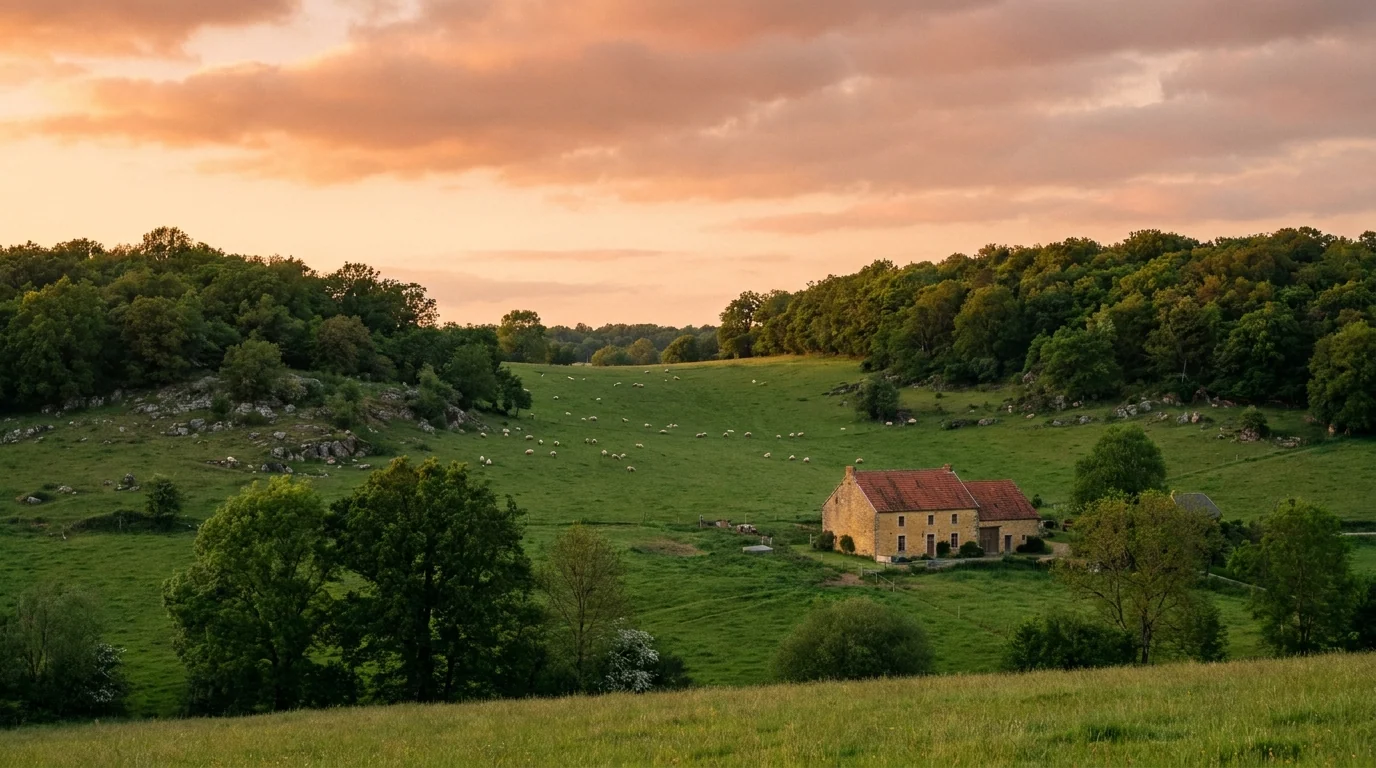
Dusk has barely fallen and already the night carries a sound that does not belong to the village. Somewhere between the wooded slopes near Chiny and the gorge bottoms that the Semois has carved into the schist, a cry rises. Long, guttural, almost gravelly. Then a second call, hoarser still, that ricochets between beech trunks like a ball in a stone corridor. This is the rut. It begins in late September in the Gaume and exhausts itself by mid-November, when the first frosts stiffen the fallen leaves.
Steep beech stands, kingdom of the red deer
The Gaume does not offer vast game-rich plains. It gives the red deer what central Ardennes often lacks: south-facing limestone slopes, cool north-facing hollows, an alternation of ancient beech stands, sessile oak high forest, and hazel thickets. The old massifs around Bouillon, Florenville, or the woods of Sommethonne shelter animals that, at autumn's turn, descend from the ridges toward the deep-cut valleys. There they find two rare things: still water in the Semois and a leaf-litter floor still soft beneath the hooves.
The very architecture of these forests plays its part. The coppice-with-stands inherited from the nineteenth century, sometimes still worked in rotational cutting, create vertical layers where a stag can cross from dark thicket to meadow in a few leaps. Bilberry heaths and blackberry margins, where the canopy opens, offer foraging relays. This is a terroir in the strict sense: a geology, a climate mild for the latitude, centuries of human labour, all woven into habitat.
The cry that pierces the November mist
The bellow is not a moo. It is a forced inhalation, a rumble pushed from the bottom of the lungs that breaks into hitches, then a falling rasp, as if the animal were apologising for having cried at all. In the Gaume in November, the air is often heavy, saturated with humidity rising from the river. That low fog, clinging to the alders along the banks, carries sound to distances that stagger the walker: a stag two hundred metres upstream can seem to roar right over your shoulder.
The stags then engage in antler jousts, pursuits through rusted bracken. The hinds, grouped in herds led by an aged doe, climb the slopes to escape the chase. Young males, still crownless or with two short spikes, stay at the edges, too vulnerable to enter the arena. The entire hierarchy of the herd rewrites itself in three weeks of cries and dull thuds against trunks.
Walking in silence, refusing to answer the call
In recent years, guided night outings have taken the curious and photographers onto the ridges above the Semois. They have a rule, tacit but strict: no speakers, no repeated calls, no white torches shone at an animal. The worthy experience is one of waiting. Sit on a stump, let the cold soak into your collar, let your eyes adjust to the blue twilight of the leafless beeches. The cry will come. It may come three times, or not at all. It does not belong to you.
In Torgny, Montquintin, Latour, the elders knew this calendar without naming it. They knew that when the stag bellows, one does not go into the valley woods, that the animals' senses are raw and that the smell of a hurried man is enough to empty a whole slope. That simple caution, inherited from forest work and winter hunting, remains the best ethics of observation. In November the Gaume does not ask to be conquered. It asks that we listen, then leave. The mist will close the slope again before dawn.
Want to discover the Gaume in person?
Six characterful houses, hot tub, walled garden — minutes from the sites we write about.
See the houses