
Torgny under bare vines: when limestone holds the last warmth
By late November, Torgny's vines have given everything. Beneath grey, knotted canes, this limestone slope — the Ardennes' little Provence — prepares the next harvest in silence.
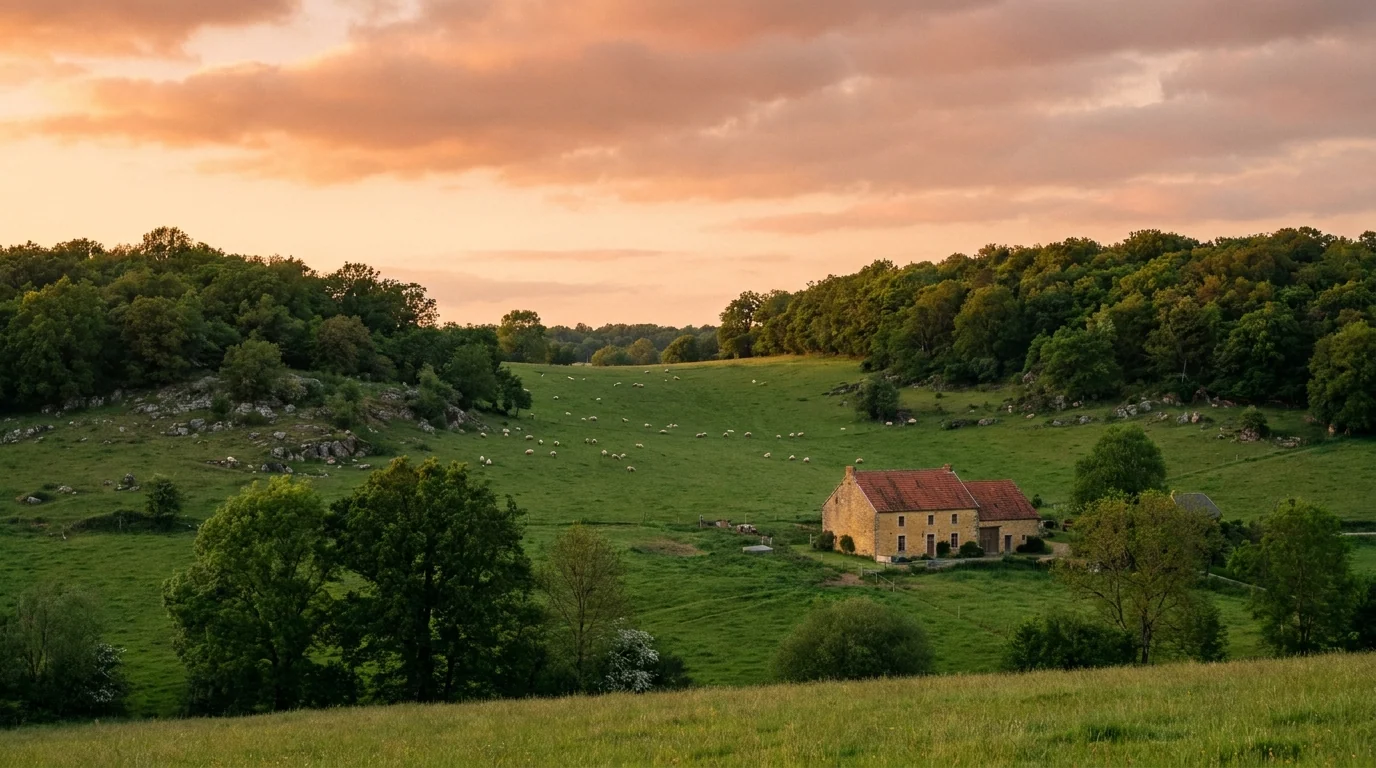
You have to descend from the plateau to understand it. The road dips toward Torgny, and in the fold of the valley, the exposure shifts. Slopes turn south, the sky widens, and the air takes on a mildness you no longer find in Bouillon or Florenville. By mid-November, the vines have completed their cycle. No clusters left, no leaves. Grey canes, knotted like clenched fists, sketch on the hillside a script you can only read in winter.
The soil that refuses winter
Here, the vine owes nearly everything to geology. Beneath the brown topsoil lies limestone, that hard white rock that stores daytime heat and releases it through the night. Autumn rains do not soak it; they pass through in silence and go down to deep aquifers. The result: the soil dries fast, warms fast, and the grapevine roots push far down to find what another season will offer. The locals call this chalky rock baillon, a word that sounds like a tender oath. It explains why Torgny, the first Walloon village from the south, grows vines where neighbouring Gaume settles for meadows and beech. Nature had not decided it. Human patience, yes.
Canes and silence
A few weeks after the harvest, the vineyard enters its pause. A time of watching, not emptiness. The vintner inspects the trunks, notes which suffered the summer drought, assesses scars left by old wire. He is already pruning mentally, walking between the rows: that cane goes at springtime, this one will carry two bunches, not three. The real secateurs cut will come in January, in the dry cold, when the sap has descended. Meanwhile, the vine sleeps standing up. A crow passes, perches on a post, surveys the slope. A tractor heads back toward the village dragging a small cloud of ochre dust. No machinery noise, no construction. Just the low late-November light stretching each vine like a Chinese shadow across the hillside.
Work at human height
No talk of giant cooperatives or cellars with a thousand vats. Torgny's vines are cultivated at village scale, often family scale. A few hectares clinging to plots that hands know trunk by trunk. Equipment is shared; pruning days are done together — a secateur cut at one farm, another at the next, with a thermos of coffee in the winter sun when it breaks through. The wine produced is modest in volume, exacting in attention. It is not shipped in cartons from a logistics warehouse; it is sold at the Sunday dinner table, to the visitor who pushes open the cellar door, to the neighbour heading back toward the Meuse with two bottles in the boot. This wine carries a slow history, that of a terroir that took centuries to convince the Belgian wine map it existed. In this late November, it is only a matter of patience. The vines wait. The limestone waits. Torgny waits for the first cut, then the buds, then the June rain. In its southern corner, Gaume grows wine the way others grow faith: without noise, with stubbornness, one season after the other.
Want to discover the Gaume in person?
Six characterful houses, hot tub, walled garden — minutes from the sites we write about.
See the houses