
Frost at Orval: Romanesque Stone Holds the Warmth of Morning
Late November, the ruins of Orval Abbey dress themselves in frost. The granite of the Chiny massif catches a raking light that turns each column into a soft torch.
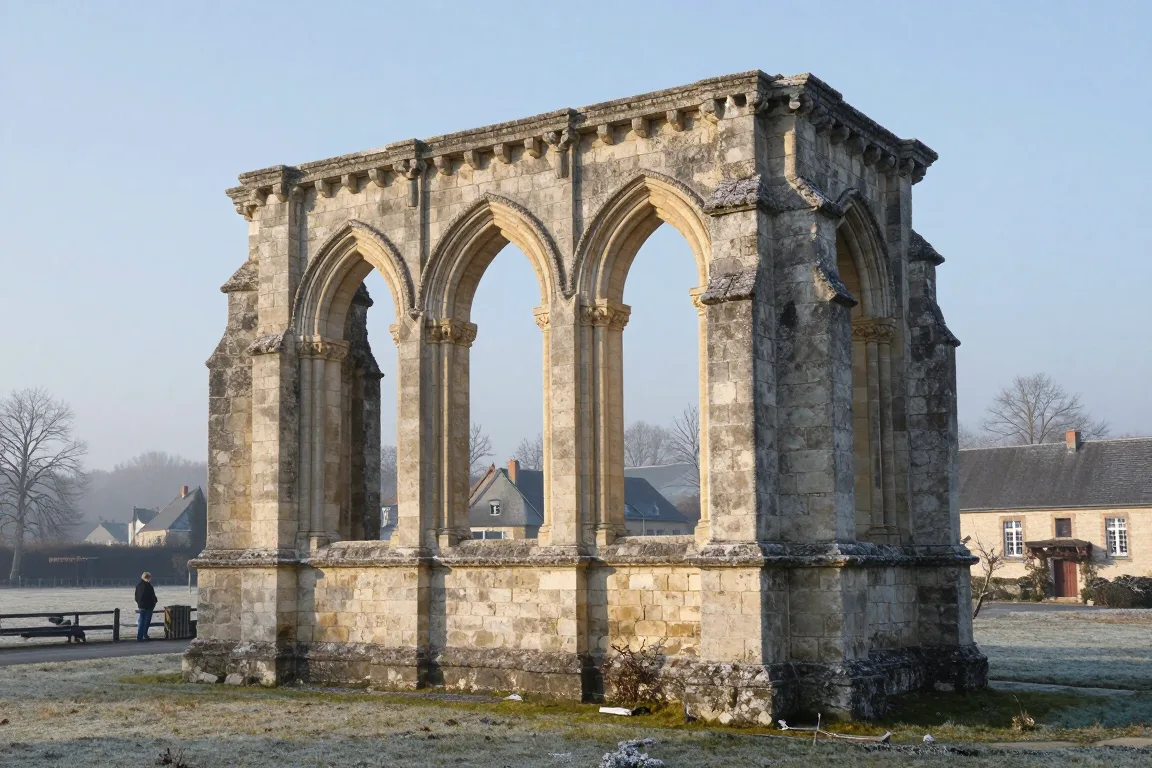
It is seven in the morning and the Creuë valley has not yet exhaled its usual mist. The high meadows around the ruined cloister gleam with tight frost, the kind of late-November frost that refuses to melt before noon and bites through shoe soles into the calf. Orval Abbey has no visitors at this hour. There is only the sound of a common buzzard wheeling above the Romanesque choir and, somewhere in the woods, the sharp snap of a branch giving way under a weight too heavy to bear.
You enter along the path that runs past the old stables. Here, the stone belongs to two orders: the rust-coloured sandstone of the Gaume country, soft, porous, the kind that drinks frost and flakes into scales; and the grey-blue granite brought down from the ridges of the Chiny massif, hard, cold, almost metallic under the palm. Frost clings first to the former, in a minuscule lace, then creeps to the second, which holds it less well. The column at the south porch is still white at mid-height when its northern neighbour has already dried.
Walls that have lost their roof
The Romanesque ruins of Orval begin with an absence. Not a sad absence, rather the gap left in a vocabulary learned in childhood. The round arches open onto a November sky, a sky without thickness, washed in dirty white. The paired windows of the cloister — those twin bays separated by a single shaft — each frame a square of hillside, a patch of frozen meadow, a beech tree's silhouette raising its last coppery leaves.
A morning, in winter, what strikes you is not the monument's grandeur. It is its weight. Romanesque stone is not looked at; it is received into the shoulders. Under the raking light, the columns cast long shadows that cross the cloister floor like bars. You walk between these shadows and feel the cold climbing up from your feet, along your shins. Frost has turned every carving into an unreadable alphabet: the fleur-de-lis, the bull's head, the leafy rinceau, all covered by a white veil that softens the angles and makes reading impossible. That is very well.
The cold that builds
People often say that frost is the enemy of heritage. At Orval, on this late-November morning, it is almost an accomplice. The cold stiffens the moss between joints, pulls spider silk taut between two modillions, pins the last ivy leaf against a capital until it freezes into copper. The Chiny massif, three kilometres further on, catches the low clouds and sends them back as fine drizzle over the ruins. This drizzle freezes overnight, and each morning the column wakes a little whiter, a little sharper.
The Trappist monks who rebuilt, in the late nineteenth century, a few hundred metres from the ruins, chose a local quarry granite for their new church. That granite does not frost the same way: it holds the day's moisture and releases it at the first ray, in a thick mist that runs slowly down the fluting. The difference between the stone of the ruins and the stone of the living monastery is a difference of breath. One breathes frost, the other breathes warmth.
By nine o'clock the buzzard has gone. The light has turned and the cloister shadows have folded back beneath the column bases. Frost has melted from the carvings, laying bare, for barely two hours, the work of whoever chiselled, nearly a thousand years ago, a leaf of vine into a block of sandstone. That is enough. You need no more to understand what cold can do to a stone, and to a morning.
Want to discover the Gaume in person?
Six characterful houses, hot tub, walled garden — minutes from the sites we write about.
See the houses