
Gaumais Washhouses: the Thinning Spring Still Holds the Laundresses' Voices
Late November: the spring slows and the washhouse falls silent. These stone basins, where Gaume's women scrubbed linen and memory, remain the last witnesses of a village that spoke around a trough.
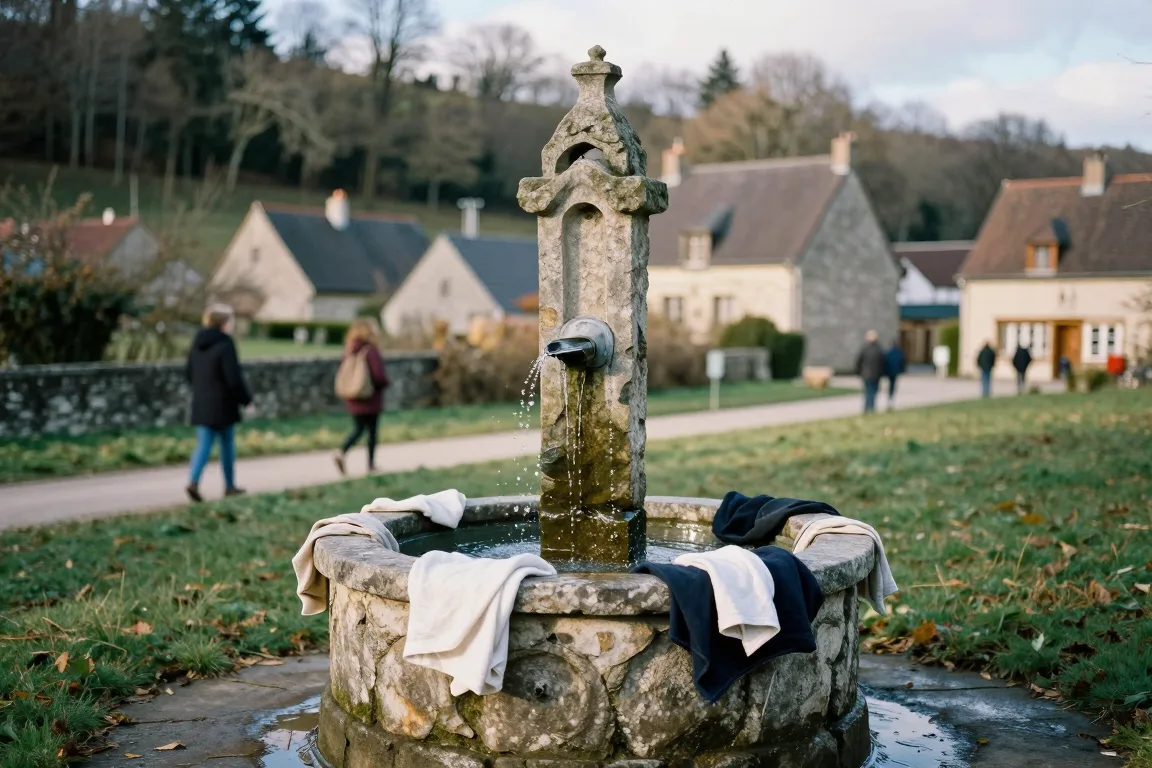
The sun slips behind the hill before half past four. In the hollow of the valley, a grey-stone washhouse exhales a fine mist. The water, thin at this time of late November, barely covers the bottom of the trough. No beaters, no laughter bouncing off the vault. Only the small murmur of a trickle over mossy sandstone. It is one of those basins built over the centuries in Gaumais villages, where a spring surfaces and yields enough flow to rinse the linen.
An architecture of usefulness
The Gaumais washhouse has nothing of a monument about it. It is, first, a village survival project: a basin carved from local stone — limestone, sandstone, sometimes schist rubble — topped by an oak frame or a barrel vault, fed by a spring captured a few metres upstream. The oldest date back to the Spanish period, others to the French regime, others still to Belgium's earliest years. Their architects were stone-cutters, village masons, anonymous labourers.
One almost always finds a sloping pavement leading down to the trough, flagstones worn by generations of kneeling knees, iron rings for strapping clothes to the rinsing stones. The low vault shields from winter frost and October rain. The acoustics are remarkable: the voice carries, doubles, bounces off damp stone. It was the village's first meeting room, open at all hours, without door or barrier.
Life was told on the wet stone
For two centuries and more, the washhouse was an all but exclusively feminine space. Men passed through sometimes, dropped a bucket, left again. The women stayed for the whole day: lye from vine-pruning ashes, scrubbing on the stones, rinsing in the running water, drying on the grass below. They also brought what the home could not offer — conversation, mutual aid, collective memory.
Here a marriage was negotiated, the buckwheat harvest debated, neighbourly quarrels mended. Here one murmured the words not spoken at church or in the tavern. Rural Gaume had no local press, no telephone: it had a washhouse. The old women still speak, when invited, of the 'sound of water on linen' that covered confidences.
November drains the memory
At this late November, the Gaumais spring is at its lowest. Dead leaves from alders and willows clog the feeding channel. December's frost will finish immobilising the surface. The washhouse becomes again what it was before the washing machine: a closed, silent space, almost sacred in its stillness.
Most serve no purpose now. Many have been restored by the communes — repointed stone, rebuilt roof, cleaned spring — but they remain orphans of their laundresses. A few, in Montquintin, Sommethonne, Latour, still hold that clear water which serves nothing but to mirror, on a frosty morning, the reflection of a century-old timber frame.
And that is already much, in a village that has lost its bread oven, its forge, its pump. The washhouse asks for nothing. It waits. As stone always waits.
Want to discover the Gaume in person?
Six characterful houses, hot tub, walled garden — minutes from the sites we write about.
See the houses