
Anlier in November: the beech cathedral puts on its copper veil
Late November, the beeches of the Anlier forest cling to their last stained-glass leaves. A thick silence descends on Wallonia's largest beechwood.
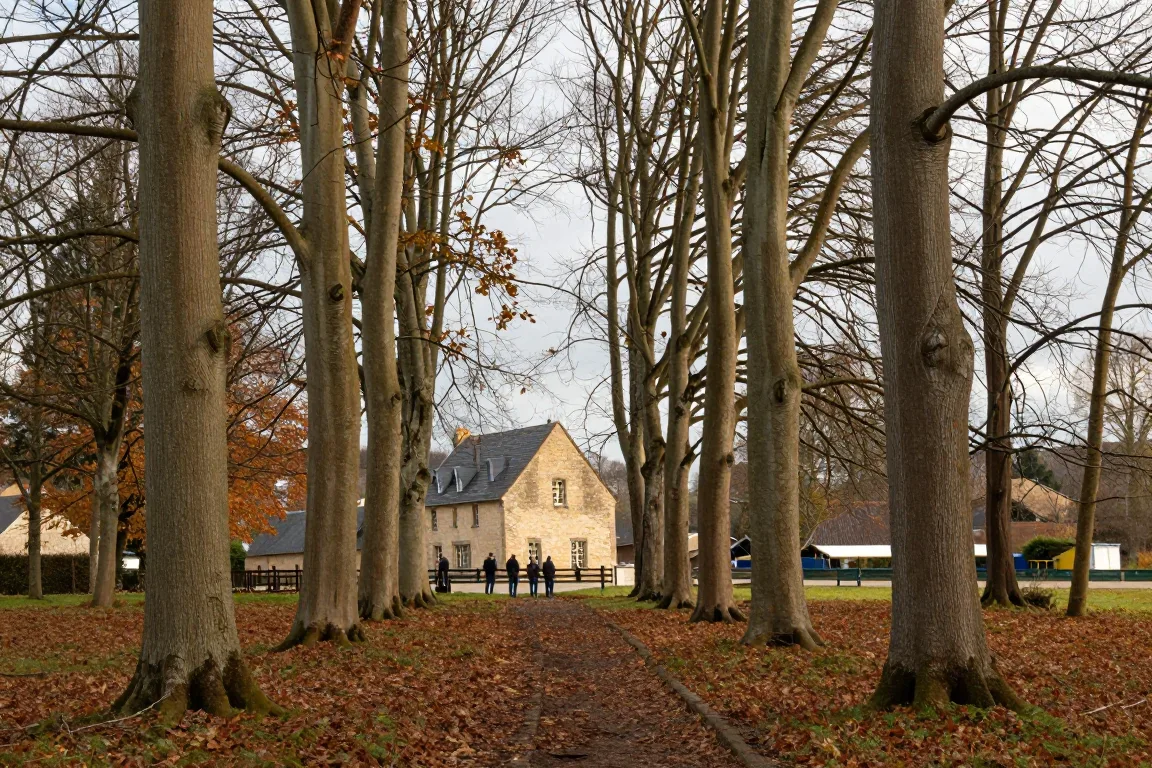
On the 24th of November, in the Anlier forest, something happens that postcards never photograph. The great beeches, those grey columns twenty metres tall, still clutch their leaves at the tips of their finest twigs. Not all of them — three-quarters have fallen, carpeting the forest floor with a thick layer of rust. But the younger branches hold on. It is called marcescence: a botanical stubbornness that refuses winter bareness, leaving small pieces of brown leather dangling all season long on the lowest boughs.
The November light is grazing, oblique, a little grey. It passes through those dry leaves and ignites them from within. The beeches take on a translucent copper hue, exactly like stained glass that the low winter sun can no longer pierce but still colours. Walking between the trunks that evening means tilting your head back toward a vault of scorched enamel trembling at the slightest breeze.
The last glass of the beeches
The Anlier forest spreads over thousands of hectares, straddling the municipality of Habay and several villages of Belgian Luxembourg. It is one of the largest beechwoods in Wallonia, perhaps in Belgium. Old-timers say that two centuries ago, woodcutters could walk three hours in the same forest without crossing a paved road. Today, even stepping onto a secondary trail off all signage, you lose all sense of distance within twenty minutes.
This late November, the ground is saturated with rain. The fallen leaves, waterlogged, cling to your sole and make every step audible. No wind. The silence of a beechwood in November is not an empty silence: it is a full, dense quiet made of distant creaks, of drops detaching themselves, of the absence of birdsong that in summer filled every corner. Tits still linger, but the thrushes are gone. The nocturnal raptors begin their watch by four o'clock.
Dead wood: a cemetery that raises
On the Anlier trails you regularly encounter beeches standing dead for three, four, five years. Shedding bark, branches bleached by rain, split trunks. The hurried walker sees an accident. The ecologist sees a building fully occupied up to the attic. Under each peeled flap of bark, beetles excavate. In the cracks, bats sleep through the day. Fungi — amber polypores, tinder conks — colonise the wood slowly, over ten, twenty years.
The Anlier forest still harbours these old trees in advanced decay, which is no longer the case everywhere. In Gaume, intensively worked plots have been stripped of their dead wood for safety and yield. The Anlier, less heavily managed on its northern slopes, keeps this architecture of the living: the dead trunk feeds its neighbour through shared roots, the fungus feeds the squirrel, the squirrel plants the acorn, the acorn makes the beechwood in three hundred years.
Walking without sound, walking alone
What strikes you in the Anlier beechwood at late November is the verticality. The trunks rise, rise, rise until they drown in a misty vault. The understorey is almost bare — beech is stingy with light at ground level, and nothing truly grows beneath it except spring anemones and bilberries on the acidic slopes. In November, the ground is a desert of layered leaves, a parquet of copper.
You walk without making a sound, almost against your will. The path twists, vanishes under moss, reappears twenty metres on. The villages — Habay-la-Vieille, Anlier, the hamlets that eye the Grand Duché — are out of sight. Sometimes you hear a motorbike on the national road, very far, a background hum reminding you that the civilised world still exists. Then nothing again.
Twenty minutes from the nearest motorway exit, Gaume still offers these secular cathedrals where the only window is a beech leaf, translucent, letting a November too brief slip through.
Want to discover the Gaume in person?
Six characterful houses, hot tub, walled garden — minutes from the sites we write about.
See the houses