
Viaducts of the dead rail: walking under rust and silence
In the Gaume, old railway lines have become walking paths. Beneath arches of stone and iron, only the sound of footsteps and the smell of humus remain.
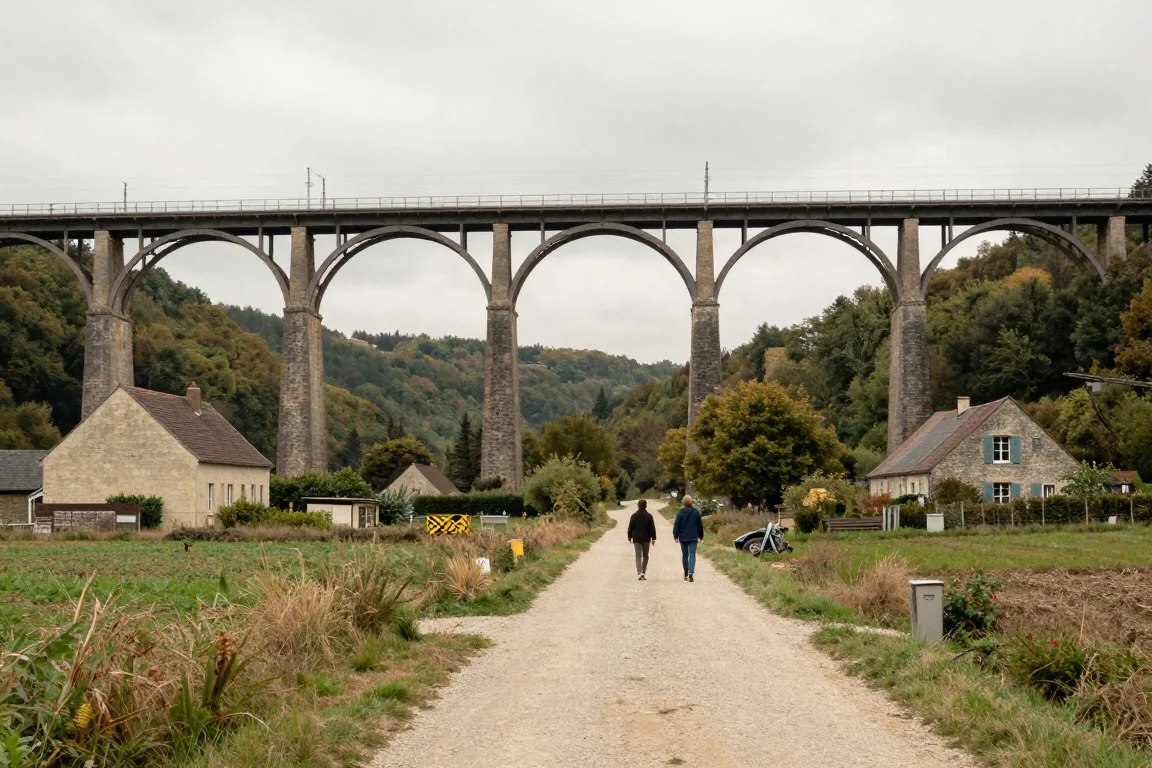
You don't walk a Gaume RAVeL path the way you walk a country lane. The trail is dead flat from one end to the other — no bend, no slope. A train doesn't climb, doesn't turn, doesn't stop to admire the valley. And the path keeps that industrial stubbornness, that straight-line resolve. In late November, when the beeches have dropped their leaves and the sky presses low over the plateau, that single line carries you effortlessly toward the first viaduct.
Crossing the bare plateau
The trail stretches between meadows browned by frost, between bare banks where the heather has blackened. No tree borders the path: clearing the old ballast stripped everything. So the wind off the plateau — the one that blows in from the French Meuse or from the deep Semois valley — hits you full-on. You walk into it, shoulders hunched, and the landscape scrolls in section-view: fields, low hedges, slate roofs in the distance. Nothing shields you, nothing diverts you. This is a railway path, not a lane. Then, abruptly, the ground vanishes beneath a three-arched bridge. You descend a steep staircase, enter under the arch of limestone rubble, and the wind noise dies at once. Only your footsteps echo in the cold stone.
What the iron left standing
These viaducts date from the nineteenth century. They carried the train linking Virton to France, hauling lime from the quarries, iron from the smelting works, potatoes from the Gaume countryside. The line closed, then the rails were pulled, then the sleepers rotted under moss. But the bridges endure. You don't demolish a Gaume stone wall the way you dismantle a fence. So they remain, draped in dry ivy this season, their parapets crusted with orange lichen. Metal has less patience: where rails were sometimes left in place, they've become thick bands of rust, so smooth to the touch you'd swear it was worn leather. Inside a tunnel, the temperature stays mild all year. In November, pressing your palm to the wall there, you feel warm stone while outside the frost bites the banks.
Walking on silence
Today, walkers have taken the locomotives' place. A man alone with a backpack. A couple on wide-tyred bicycles. A dog loping through wild grass between pulled-up rails. Nobody blows a departure whistle anymore, nobody shouts through a megaphone. It is the silence of an industrial church. Children born in the villages the trail passes through have never heard a train: to them, this bridge isn't a relic — it's a natural thing, like an old farm wall. And perhaps that's fine. The viaduct no longer needs to bear weight to exist. It bears the memory of those who built it by hand, in the January cold, with stones cut from the plateau's quarries. Walking beneath it, listening to your own footsteps rebound off the vault, you give them something back. Not a tribute. Just the living noise the stone had been waiting for.
Want to discover the Gaume in person?
Six characterful houses, hot tub, walled garden — minutes from the sites we write about.
See the houses