
Latour: The Feudal Ruin Above the Semois Bend
In November, bare trees finally lay bare the promontory of Latour. The Semois carves its tight loop below, and the castle ruins reclaim their full place in the low, slanting light.
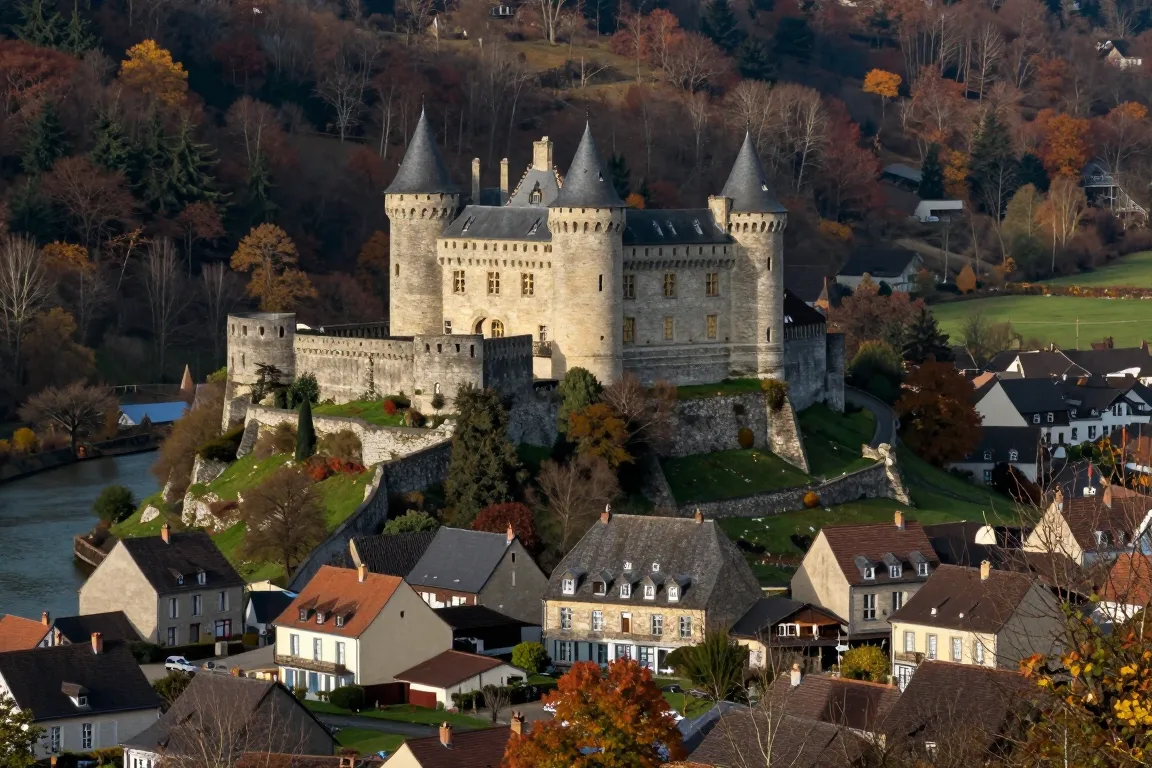
November is the month Latour reveals itself. No foliage to mask the cliff, no canopy to soften the slope. The limestone promontory appears in its grey nudity, and the village clinging to it seems to have always been there, set on a rock the river chose to circle.
Below, the Semois draws a tight bend, almost a complete loop around the spur. It is this geography — a meander, a gorge, a single dry crossing over miles — that made Latour a strategic lock for centuries.
The promontory and its keepers
The castle of Latour was not scenery. It commanded the only point where the Semois could be forded, where the loop strangled the territory. The lords of the place swore fealty alternately to the Duke of Luxembourg and the French counts of Meuse, depending on which way the wind blew at court. Latour, in this Gaume of margins, was never a peaceful seat.
Of the medieval fortress, what remains is foundations, a wall fragment, the footprint of a tower. Nothing spectacular. Just the trace of a volume on the ground, like a sentence erased but whose punctuation you can still make out. The village goes on around it. Houses press together upstream of the promontory, facing south, leaning against the holding earth.
Naked stone under low light
Late November, the sun grazes the horizon. Light enters through the river bend and sweeps the cliff at a slant, revealing the layering of Gaume sandstone, veins of limestone, chisel scars. It is a moment of transparency: roots of oaks uprooted in summer leave the soil profile visible, every exposed stone showing.
Wind comes up the valley whistling between rocks. On the spur, bare branches sketch a black net against a lead sky. The ruins do not seek to please. They hold because the rock retains them, and because no one thought it proper to remove them. It is also a form of peasant loyalty: leave the stone where it is, as long as it does not block the cattle path or the climb up to the garden.
The meander that decides the village
The Semois is not a backdrop in Latour. It is the reason for the village. Without this bend, no promontory, no castle, no town clinging to the slope. The water's course decides everything: where to build, where to cultivate, where to go down for water, where to climb back up gasping in the evening.
Terraced gardens, a few squares of earth between houses and river, receive the only heat sufficient to ripen a squash or a leek. By December, frost will cover them. In June, they smell of embers and cut grass. But in November they rest, and the Semois rolls its grey waters at the foot of collapsed stone walls.
One can walk the path along the cliff, descend to the ford, climb back up the Sentier des Vaux. Nothing extraordinary. An ordinary walk through an ordinary village. Except that the ground underfoot is made of memory, and the river, for its part, keeps turning.
Want to discover the Gaume in person?
Six characterful houses, hot tub, walled garden — minutes from the sites we write about.
See the houses